Why the Same Branded Power Bank Gets Accepted by One Client and Rejected by Another in the UAE Corporate Gifting Market
Published · Written by Compliance Review Desk
Written by: Emirates Tech Works Compliance Review Desk
Reviewed by: Emirates Tech Works Procurement Editorial Team (Procurement scope review). This is an organisational review role, not an individual endorsement.
There is a pattern we see repeatedly on the production floor that rarely gets discussed in procurement meetings. A corporate buyer places an order for five hundred branded power banks—same model, same branding, same packaging—intended for distribution across several client accounts in Dubai and Abu Dhabi. The product clears quality inspection, ships on schedule, and arrives in perfect condition. Within two weeks, the buyer reports that three of the five recipient organisations accepted the gift without issue, one returned the entire shipment citing policy restrictions, and the fifth requested a formal declaration letter before distribution could proceed. The product was identical in every case. The difference was entirely in the recipient's industry.
This is where gift type selection decisions begin to fracture in ways that most procurement briefs never anticipate. The assumption embedded in most corporate gifting programmes is that once a product category has been approved—say, branded tech accessories—the specification within that category is interchangeable across all recipient contexts. In practice, this assumption creates a systematic vulnerability that surfaces only after production is complete and delivery has been attempted.
The issue is not about gift value thresholds, which most procurement teams understand reasonably well. It is about specification-level compliance divergence across recipient industries.
!Matrix showing how different tech gift specifications receive different acceptance outcomes across industry sectors in the UAE A power bank with a 20,000mAh lithium-ion battery, for instance, is a perfectly standard corporate gift for a technology company or a real estate developer. But the same unit sent to a government ministry may trigger security review protocols because of its battery classification. A Bluetooth speaker with an integrated microphone is a thoughtful gift for a marketing agency but may be flagged as a potential recording device by a financial institution's compliance team. A USB flash drive pre-loaded with a company presentation is a creative touch for a logistics firm but represents a data security violation for any organisation operating under ISO 27001 or similar information security frameworks.
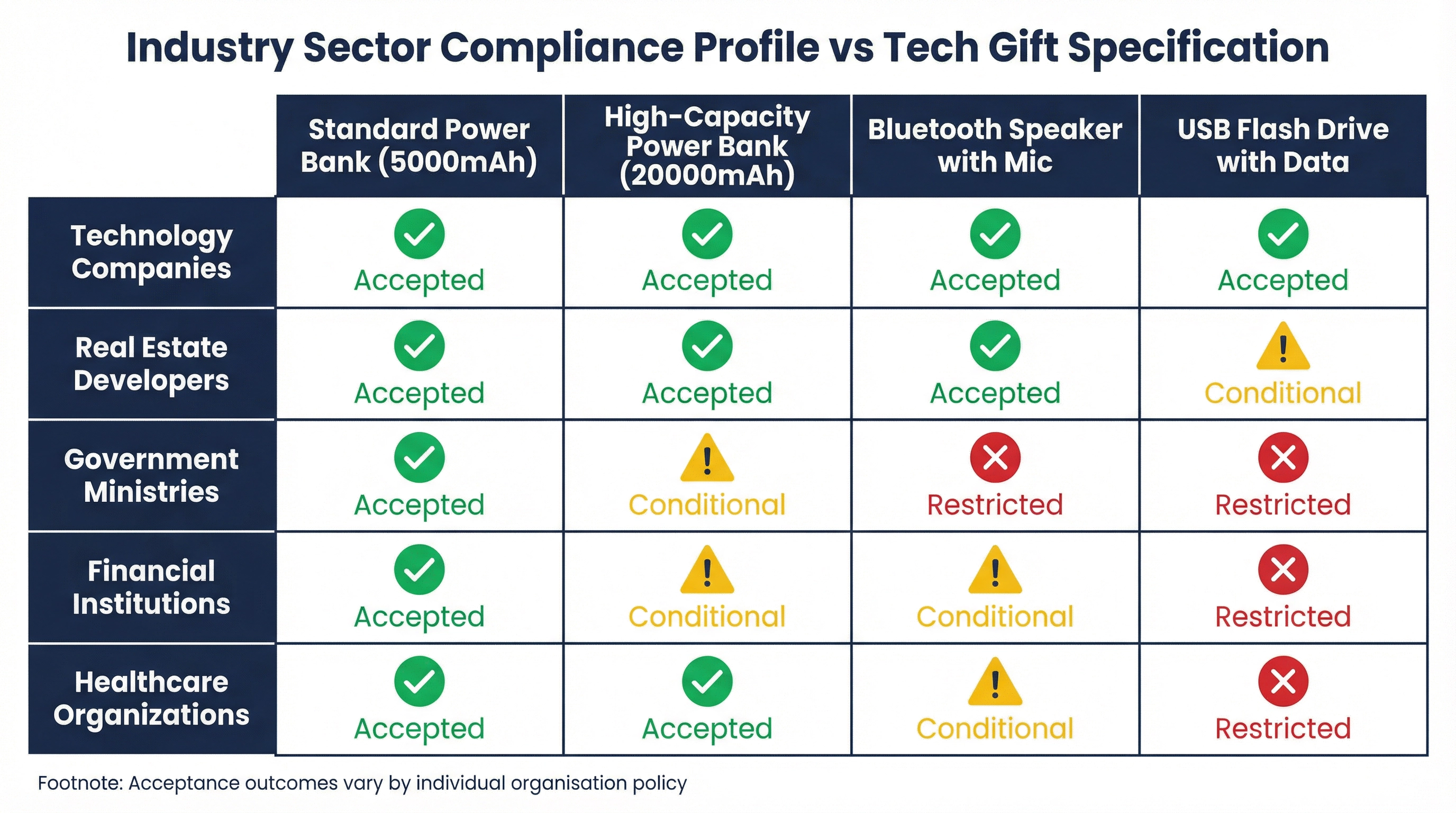
From the factory side, we see this play out as a specification problem that should have been resolved during the briefing stage but almost never is. The procurement brief typically specifies: product type, quantity, branding placement, packaging style, and delivery timeline. What it almost never specifies is the compliance environment of the end recipient. The factory produces exactly what was ordered. The quality control team inspects against the specification provided. Everything passes. The failure occurs downstream, at the point of acceptance, where the recipient's internal policies interact with the product's technical characteristics in ways the buyer did not anticipate.
The practical consequence is not merely an awkward moment. Rejected corporate gifts create a cascade of operational problems. The inventory cannot simply be redirected to another recipient without re-evaluating whether the same specification conflict exists elsewhere. Return shipping from UAE-based recipients back to the warehouse incurs cost and delay. If the gift was personalised with the recipient's logo alongside the sender's branding, the returned units cannot be repurposed at all. And the relationship signal sent by a rejected gift—regardless of the reason—is difficult to recover from. The recipient's procurement or compliance team now associates the sender with insufficient due diligence.
What makes this particularly difficult to manage is that the compliance frameworks governing gift acceptance vary not just by industry but by organisation within the same industry. Two banks operating in the UAE may have materially different gift acceptance policies. One may permit branded tech accessories up to AED 500 with no restrictions on product type. Another may prohibit any electronic device with data storage capability regardless of value. A government entity may accept gifts during certain periods but impose blanket restrictions during others. Healthcare organisations operating under international pharmaceutical compliance frameworks may require that all gifts be logged, declared, and approved before physical acceptance.
The correction is not to abandon tech gifts for these sectors—branded power banks, wireless chargers, and Bluetooth speakers remain among the most effective corporate gift categories across the UAE market. The correction is to build industry-sector awareness into the specification stage, before the production order is finalised. This means the procurement brief needs to include not just "what are we sending" but "what compliance environment is the recipient operating within." For organisations that manage corporate gift programmes spanning multiple business contexts, this distinction between product category approval and specification-level compliance is the difference between a programme that runs smoothly and one that generates rejection incidents with every distribution cycle.
From a production planning perspective, the adjustment is smaller than most buyers expect. The same base product—a branded power bank, for example—can be produced in two or three specification variants that address the most common compliance friction points. A lower-capacity variant without USB data transfer capability for government and financial sector recipients. A standard variant with full functionality for technology and commercial sector recipients. The branding and packaging can remain consistent across variants, so the programme still feels unified. The unit cost difference between variants is typically marginal—often less than the cost of a single rejected shipment's return logistics.
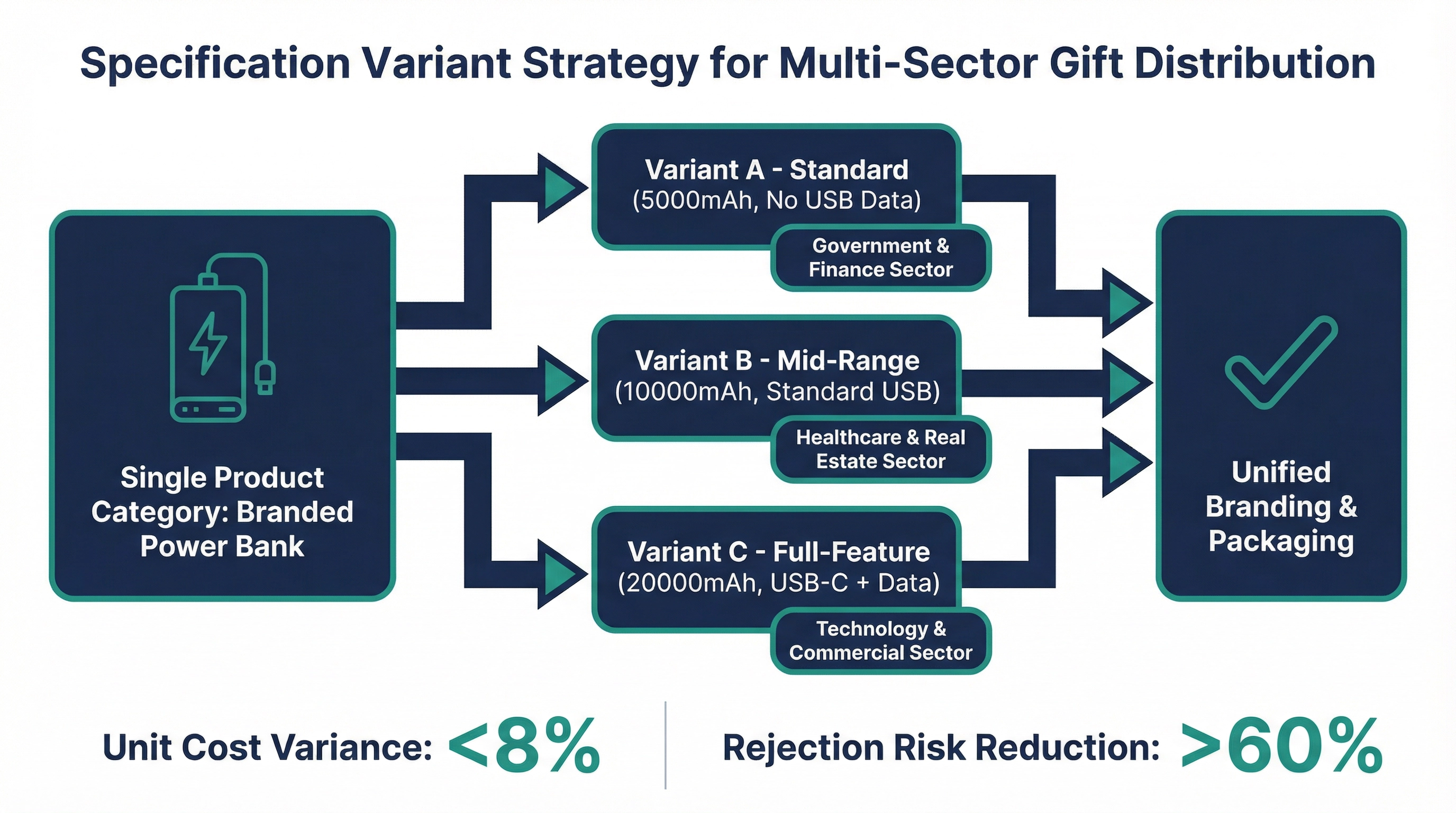
The deeper issue is that most procurement teams treat gift type selection as a single decision point: choose the category, approve the specification, and distribute uniformly. The reality in the UAE's multi-sector business environment is that gift type selection is a matrix decision, where the product specification must be cross-referenced against the recipient's industry compliance profile before the order is placed. Treating it as a single decision is what creates the pattern of partial acceptance and partial rejection that erodes both budget efficiency and programme credibility over successive gifting cycles.