Why Your "Premium Tech Gift" Strategy for UAE Enterprise Clients Creates the Opposite Perception You Intended
Published · Updated · Written by Product & Production Review Desk
Written by: Emirates Tech Works Product & Production Review Desk
Reviewed by: Emirates Tech Works Procurement Editorial Team (Procurement relevance review). This is an organisational review role, not an individual endorsement.
When our procurement team reviewed a UAE-based B2B software company's corporate gifting strategy last quarter, the disconnect was immediate. Their gift selection logic followed a familiar pattern: "Our clients are tech companies, so we'll gift premium tech products—wireless charging stations, noise-canceling headphones, smart home devices. Higher perceived value equals stronger relationships."
The reality revealed itself in client feedback six months later. Recipients described the gifts as "redundant," "tone-deaf," and—most damaging—"a signal they don't understand our business." The company had invested significant resources in gift procurement, only to create a perception gap that undermined the relationship-building objective they were trying to achieve.
This misjudgment isn't about product quality or budget allocation. It's about a structural flaw in gift type selection: prioritizing perceived value signals over actual business objective alignment. In UAE corporate tech gift markets—where selecting the right gift type for different business needs requires navigating complex decision variables—this creates a three-layer problem that compounds across supply chain, cultural perception, and relationship dynamics.
The Perceived Value Trap: Why "Premium" Doesn't Equal "Appropriate"
The default gift selection criterion in most corporate procurement processes is perceived value. Teams benchmark against competitors, consult industry best practices, and select gift types that signal investment and thoughtfulness through price point and brand recognition. For tech-focused relationships, this typically translates to premium tech gadgets—products with high retail visibility and clear monetary value.
The logic appears sound: if we're gifting a $150 wireless charging station versus a $30 notebook set, the higher-value item should create a stronger impression. But this assumes recipients evaluate gifts primarily through monetary value, when in practice they filter gift type selection through three perception lenses that determine whether the gift strengthens or damages the relationship.
Redundancy perception emerges when gift type overlaps with the recipient's existing resources or expertise. A tech company receiving tech products triggers the question: "Why are they gifting us something we can easily procure ourselves—often at better terms through our own supplier relationships?" The gift doesn't demonstrate understanding; it reveals a lack of differentiation. In UAE enterprise relationships where supplier selection signals domain expertise, redundancy perception translates to competence doubt.
Misalignment perception occurs when gift type contradicts the business relationship's value proposition. A software services company gifting physical tech products creates cognitive dissonance: "If they have budget for premium gadgets, why not invest in improving software support quality or reducing bug resolution time?" The gift becomes evidence of misplaced priorities rather than appreciation. This is particularly damaging in UAE markets where business relationships carry implicit expectations about resource allocation alignment.
Over-investment perception appears when gift value exceeds the relationship's current depth or transaction frequency. Gifting $150 items to prospects who haven't yet committed to a contract, or to clients with annual contract values under $10K, creates discomfort rather than gratitude. Recipients question the sender's business judgment: "Why are they spending this much on gifts when we're evaluating their cost efficiency?" In UAE corporate culture where financial prudence is valued, over-investment signals poor resource management.
These perception filters operate simultaneously.
!Gift Type Perception Filter Matrix showing how different gift categories (Premium Tech, Operational Consumables, Experiential Gifts) are evaluated through three perception lenses (Redundancy, Misalignment, Over-Investment) with risk level indicators for UAE corporate tech gift selection A premium tech gift to a tech client can trigger all three: redundant (they have better versions), misaligned (why not improve service?), and over-invested (this seems wasteful). The sender's intent—demonstrate value appreciation—never reaches the recipient because the gift type choice blocks the message at the perception layer.

The Supply Chain Reality Check: How Gift Type Selection Creates Procurement Conflicts
The perceived value trap becomes operationally expensive when supply chain constraints collide with gift type selection. Premium tech products carry procurement characteristics that conflict with typical relationship-building timelines and budget structures, creating a secondary layer of misalignment that compounds the perception problem.
MOQ constraints for customized premium tech products typically range from 100-500 units. A UAE company with 30 enterprise clients faces an immediate mismatch: order 100 units to meet MOQ (leaving 70 units in inventory), or skip customization entirely (losing brand visibility). Neither option aligns with the original objective. The MOQ constraint forces a choice between over-procurement and under-customization, both of which reduce gift effectiveness.
Lead time conflicts emerge because premium tech products require 6-12 weeks for customization and production. Relationship-building opportunities—contract renewals, project milestones, executive visits—operate on 2-4 week notice windows. By the time customized gifts arrive, the relationship moment has passed. Companies either gift generic products (losing differentiation) or miss the timing window entirely (losing relevance). In UAE markets where timing signals attentiveness, lead time conflicts create perception damage beyond the gift itself.
Customization complexity for tech products introduces technical constraints that limit brand application. Wireless chargers have limited printable surface area. Headphones require specialized pad printing for curved surfaces. Smart devices may have firmware restrictions on startup logo customization. Each constraint reduces brand visibility, which was the original justification for selecting premium products. The gift type that promised high perceived value delivers low brand recall because the product format doesn't support effective customization.
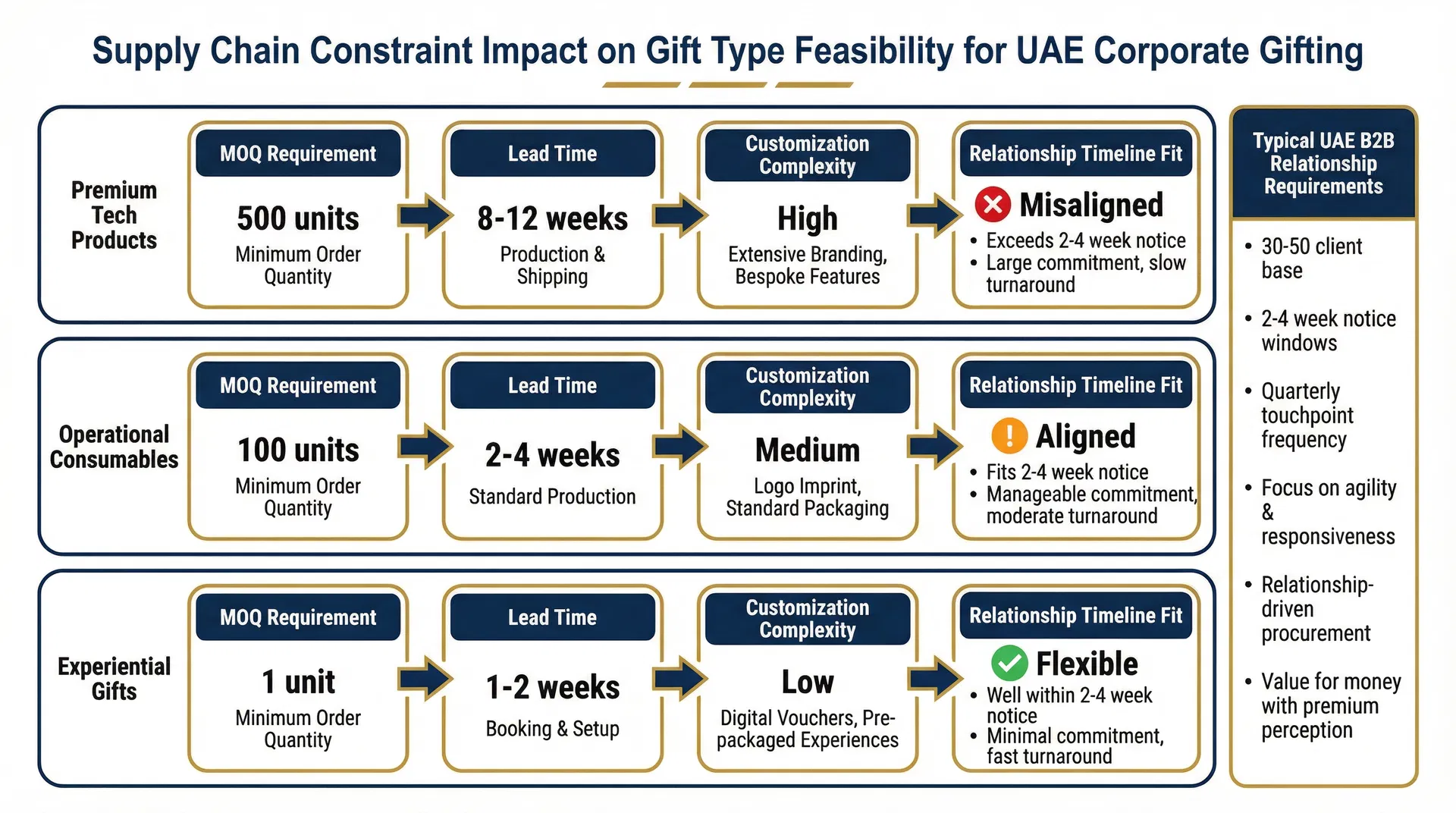
These supply chain realities force procurement teams into compromise positions: accept high MOQ for small client bases, tolerate long lead times for time-sensitive gifting, or reduce customization quality to fit product constraints. Each compromise erodes the perceived value that justified the gift type selection in the first place. The result is a gift that's expensive to procure, difficult to customize, and misaligned with relationship timing—before it even reaches the recipient's perception filters.
The UAE Market Perception Amplifier: How Cultural Context Magnifies Gift Type Misjudgments
In UAE corporate culture, gift type selection carries additional signaling weight beyond the gift itself. Recipients evaluate not just what was gifted, but what the gift type choice reveals about the sender's understanding of local business norms, cultural values, and relationship expectations. This creates a perception amplifier where gift type misjudgments that might be overlooked in other markets become relationship-damaging signals in UAE contexts.
Category redundancy in tech-to-tech gifting is particularly visible in UAE markets where corporate procurement teams have established supplier relationships across all major tech categories. When a B2B software company gifts wireless chargers to an enterprise client, the recipient's procurement team immediately recognizes: "We source these at 40% below retail through our Shenzhen supplier network." The gift doesn't demonstrate thoughtfulness; it reveals the sender doesn't understand the recipient's procurement capabilities. In UAE business culture where supplier network quality signals operational maturity, this creates competence doubt that extends beyond the gift itself.
Value signal misinterpretation occurs because UAE corporate culture distinguishes between appropriate investment and wasteful spending. A $150 tech gift to a client with a $50K annual contract value may be perceived as poor resource allocation rather than generosity. The recipient's calculation is immediate: "This gift represents 0.3% of our annual spend. Why aren't they investing this in service quality improvements that would benefit us more?" The gift becomes evidence of misplaced priorities. This is amplified in UAE markets where financial prudence and ROI-focused decision-making are explicit cultural values.
Relationship stage mismatch appears when gift type implies intimacy or partnership depth that doesn't match the current business relationship. Experiential gifts (spa packages, dining vouchers) or highly personalized items suggest a relationship closeness that may not exist yet. In UAE corporate culture where relationship progression follows defined stages—initial contact, evaluation, partnership, strategic alliance—gifting ahead of the current stage creates discomfort. Recipients perceive it as presumptuous rather than generous, potentially damaging progression to the next relationship stage.
These cultural perception amplifiers mean that gift type misjudgments in UAE markets carry higher relationship costs than in markets with more flexible gifting norms. A tech gift that would be neutrally received in Western markets becomes a negative signal in UAE contexts where gift type selection is evaluated as evidence of cultural competence and business judgment.
The Hidden Cost Structure: What Gift Type Misalignment Actually Wastes
The financial impact of gift type misalignment extends far beyond the per-unit product cost. When procurement teams calculate gifting ROI, they typically focus on product price multiplied by quantity. But the actual cost structure includes four hidden expense categories that emerge from selecting gift types based on perceived value rather than business objective alignment.
Inventory carrying costs accumulate when MOQ requirements force bulk ordering for small recipient populations. A company ordering 100 customized wireless chargers for 30 clients carries 70 units in inventory. At $150 per unit, that's $10,500 in tied-up capital. If the product becomes outdated before use (tech products have 12-18 month relevance windows), the entire inventory investment is written off. The perceived value strategy creates a structural over-procurement problem that compounds annually.
Opportunity costs emerge from budget allocation to high-value gifts that could have funded more frequent, lower-value touchpoints. A $150 gift delivered once annually provides one relationship moment. The same budget could fund three $50 gifts across the year—contract signing, mid-year review, year-end appreciation—creating three touchpoints with higher cumulative relationship impact. The perceived value strategy optimizes for single-event impact rather than relationship continuity, reducing total relationship-building effectiveness per dollar spent.
Relationship repair costs appear when gift type misjudgment creates perception damage that requires active correction. A client who perceives a tech gift as "tone-deaf" doesn't simply ignore it—they update their mental model of the sender's business understanding. Repairing this perception requires additional relationship investment: more frequent communication, more careful needs assessment, potentially more conservative business proposals. The cost isn't visible in procurement budgets, but it's real in terms of extended sales cycles and reduced win rates.
Strategic inflexibility costs accumulate because high-MOQ, long-lead-time gift procurement locks in gift type decisions months in advance. When relationship priorities shift—a key client changes decision-makers, a prospect accelerates their evaluation timeline, a partnership opportunity emerges unexpectedly—the procurement team can't respond with appropriate gifts because inventory and lead times are committed to the original strategy. The perceived value approach creates strategic rigidity that reduces relationship-building agility.
When these hidden costs are included, the total cost of a perceived-value gift strategy often exceeds 2-3x the visible product procurement cost. A $15,000 annual gifting budget becomes a $30,000-45,000 total relationship investment when inventory waste, opportunity costs, and strategic inflexibility are factored in. The ROI calculation shifts dramatically when the denominator includes actual total cost rather than just product price.
The Business Objective Alignment Framework: Selecting Gift Types That Match Relationship Goals
The alternative to perceived value selection is business objective alignment—choosing gift types based on what the relationship actually needs rather than what signals high investment. This requires mapping gift type characteristics to specific relationship objectives, then validating whether the gift type's supply chain profile supports the relationship timeline.
Objective clarity starts with defining what the gift is meant to achieve. "Strengthen client relationships" is too vague to guide gift type selection. "Increase touchpoint frequency with decision-makers in Q2 ahead of contract renewal" is specific enough to evaluate gift type fit. For this objective, gift type requirements become clear: low per-unit cost (enables multiple touchpoints), short lead time (supports quarterly cadence), high customization visibility (reinforces brand recall at each touchpoint). Premium tech products fail all three criteria. Lower-value, faster-turnaround items like customized notebooks, branded USB drives, or practical desk accessories align better.
Recipient context validation requires understanding what the recipient already has access to and what would create genuine utility. For tech company clients, tech products are commodities—they have procurement channels, volume discounts, and internal IT standards. Gifting tech creates redundancy. But operational consumables—quality notebooks, premium pens, desk organization tools—may not be prioritized in corporate procurement despite daily use. These items create utility without redundancy. The validation question isn't "What's valuable?" but "What would they not procure for themselves despite finding it useful?"
Supply chain feasibility check evaluates whether the gift type's MOQ, lead time, and customization requirements align with the relationship timeline and budget structure. If the objective requires quarterly gifting to 30 clients (120 total units annually), gift types with 500-unit MOQs are automatically disqualified regardless of perceived value. If relationship moments operate on 3-week notice (executive visits, project milestones), gift types with 8-week lead times can't support the objective. The feasibility check eliminates gift types that can't operationally deliver on the relationship objective, narrowing options to those that align with both recipient context and procurement constraints.
Cultural appropriateness filter for UAE markets adds an additional validation layer: does this gift type align with local business culture's expectations about relationship stage, value signals, and professional boundaries? Experiential gifts may be appropriate for strategic partnerships but premature for evaluation-stage prospects. High-value items may signal commitment in some contexts but wastefulness in others. The filter requires understanding UAE corporate culture's implicit rules about gift type appropriateness across relationship stages and business contexts.
When these four validation steps are applied sequentially, gift type selection becomes a constraint-satisfaction problem rather than a perceived-value optimization. The goal isn't to maximize gift value; it's to find the gift type that satisfies objective requirements, recipient context, supply chain constraints, and cultural appropriateness simultaneously. This typically results in lower per-unit cost, higher procurement flexibility, and better relationship alignment than perceived-value strategies.
Practical Procurement Implications: What This Means for UAE Corporate Gift Sourcing
For procurement teams managing corporate gifting in UAE markets, shifting from perceived value to business objective alignment requires three operational changes that affect sourcing strategy, supplier relationships, and budget allocation.
Supplier diversification becomes necessary because different gift types require different supplier capabilities. Premium tech products typically come from specialized electronics manufacturers with high MOQs and long lead times. Operational consumables (notebooks, pens, desk accessories) source from promotional products suppliers with lower MOQs and faster turnaround. Experiential gifts require relationships with service providers rather than product manufacturers. A perceived-value strategy concentrates spend with one supplier type; an objective-alignment strategy distributes spend across multiple supplier categories to maintain flexibility across different relationship objectives.
Procurement timeline restructuring shifts from annual bulk orders to quarterly or monthly smaller batches. Instead of ordering 500 units in January for year-round use, procurement orders 100-150 units quarterly based on updated relationship priorities and upcoming relationship moments. This reduces inventory carrying costs, increases strategic flexibility, and allows gift type selection to adapt to changing relationship contexts. The trade-off is higher per-unit costs (smaller batches reduce volume discounts) and increased procurement overhead (more frequent ordering). But the total cost is often lower when inventory waste and opportunity costs are included.
Budget reallocation moves spend from high-value, low-frequency gifts to moderate-value, high-frequency touchpoints. Instead of $150 gifts once annually to 30 clients ($4,500 total), the budget funds $40 gifts quarterly to the same population ($4,800 total for four touchpoints). The per-event cost is lower, but the total relationship investment is similar while creating 4x the relationship moments. This reallocation requires convincing stakeholders that relationship impact comes from touchpoint frequency and relevance rather than single-event perceived value—a mindset shift that challenges conventional gifting assumptions.
These operational changes don't reduce gifting effectiveness; they reallocate procurement resources from perceived value signals to actual relationship-building mechanics. The result is a gifting strategy that costs similar amounts but delivers higher relationship ROI through better objective alignment, recipient relevance, and cultural appropriateness.
The perceived value trap in corporate gift selection isn't about insufficient budget or poor product quality. It's about optimizing for the wrong variable—maximizing gift value rather than maximizing relationship alignment. In UAE corporate tech gift markets, this creates a compounding problem: gifts that are expensive to procure, difficult to customize, misaligned with relationship timing, and filtered out by recipient perception before they can deliver relationship impact. The solution isn't higher budgets or premium products; it's gift type selection that starts with business objectives, validates against recipient context and supply chain constraints, and filters through cultural appropriateness before considering perceived value. When procurement teams make this shift, gifting becomes a strategic relationship tool rather than an expensive perception gamble.