Why the Same Branded Power Bank Specification Fails Differently When Sent to Your Own Team Versus a Client's Executive Suite
Published · Written by Compliance Review Desk
Written by: Emirates Tech Works Compliance Review Desk
Reviewed by: Emirates Tech Works Procurement Editorial Team (Procurement scope review). This is an organisational review role, not an individual endorsement.
There is a pattern that surfaces repeatedly in corporate tech gifting programmes across the UAE, and it begins with a decision that feels entirely rational at the time. A company needs branded tech gifts for two purposes: an internal employee appreciation campaign and an external client relationship initiative. The procurement team, understandably looking for efficiency, writes a single specification brief and orders one product—typically a branded power bank, wireless charger, or Bluetooth accessory—in sufficient quantity to cover both audiences. The logic is straightforward: one product, one supplier, one quality control cycle, lower unit cost. From a compliance and quality perspective, though, this is precisely where the gift type decision begins to fracture in ways that are not immediately visible.
The fundamental issue is that internal and external audiences interpret the same physical object through entirely different evaluative frameworks. When an employee receives a company-branded power bank at a team event, the branding is not just acceptable—it is expected. The gift functions as a recognition token within an existing identity structure. The employee already wears the brand, already operates within its visual language, already understands the gesture as part of a broader appreciation programme. The branding reinforces belonging. The specification priorities for this context are durability, consistent colour matching to corporate standards, and reliable functionality across a large batch. Minor cosmetic variance across five hundred units is tolerable because the gift's primary function is participatory, not relational.
When that identical power bank arrives on a client's desk—same logo placement, same colour, same packaging—the evaluative framework shifts entirely. The client did not ask to carry your brand. The logo that signalled belonging to an employee now signals promotion to an external recipient. A 10,000mAh power bank with a full-wrap logo print that felt like a team badge internally now feels like a marketing collateral piece externally. The specification that was perfectly adequate for one audience actively undermines the objective with the other. In practice, this is often where gift type decisions for different business needs start producing outcomes that contradict the original intent.
The compliance dimension compounds this divergence in ways that procurement teams rarely anticipate during the briefing stage. In the UAE and broader GCC market, internal gifting to employees typically falls under HR recognition policy with relatively generous thresholds—AED 200 to AED 500 per item is common for annual appreciation events, and the primary compliance concern is equitable distribution across departments and seniority levels. External gifting, however, triggers an entirely different compliance architecture. Anti-bribery frameworks, client-side gift acceptance policies, and sector-specific regulations in banking, government, and healthcare all impose constraints that affect not just the value but the type of gift that can be received. A branded tech accessory valued at AED 150 may pass internal HR policy without scrutiny, but the same item sent to a government procurement officer may require formal declaration or may be declined outright—not because of its value, but because of its branding intensity and perceived promotional character.
This is the specification divergence that most procurement briefs fail to capture. The brief typically specifies product category, unit budget, quantity, and branding requirements. It rarely specifies audience-differentiated branding intensity, packaging hierarchy, or compliance-adjusted product selection. The factory receives a single set of instructions and produces a single product. The quality control team inspects against one standard. The result is a product that is technically compliant with the brief but structurally misaligned with half of its intended deployment.
From a production standpoint, addressing this divergence does not necessarily require ordering two completely different products. It often requires ordering the same base product with two different finishing specifications. An internal-audience power bank might carry a full-colour logo with the company tagline, packaged in branded corrugated boxes suitable for bulk distribution at a company event. The external-audience version of the same power bank might carry a subtle debossed logo without the tagline, packaged in a presentation box with a matte finish and a handwritten-note slot. The base unit cost difference is negligible—perhaps AED 3 to AED 8 per unit for the packaging upgrade and branding modification. But the perceived difference to the recipient is substantial, and the compliance profile changes meaningfully.
The organisations that manage corporate gift type selection across different business contexts most effectively are those that build audience segmentation into the procurement brief before the product category is even selected. They do not ask "what tech gift should we order?" as a single question. They ask it twice—once for the internal programme with its emphasis on brand reinforcement and equitable distribution, and once for the external programme with its emphasis on relationship signalling and compliance alignment. The gift type may end up being the same category, but the specification, branding treatment, and packaging will diverge in ways that make each version appropriate for its actual audience rather than a compromise that serves neither well.
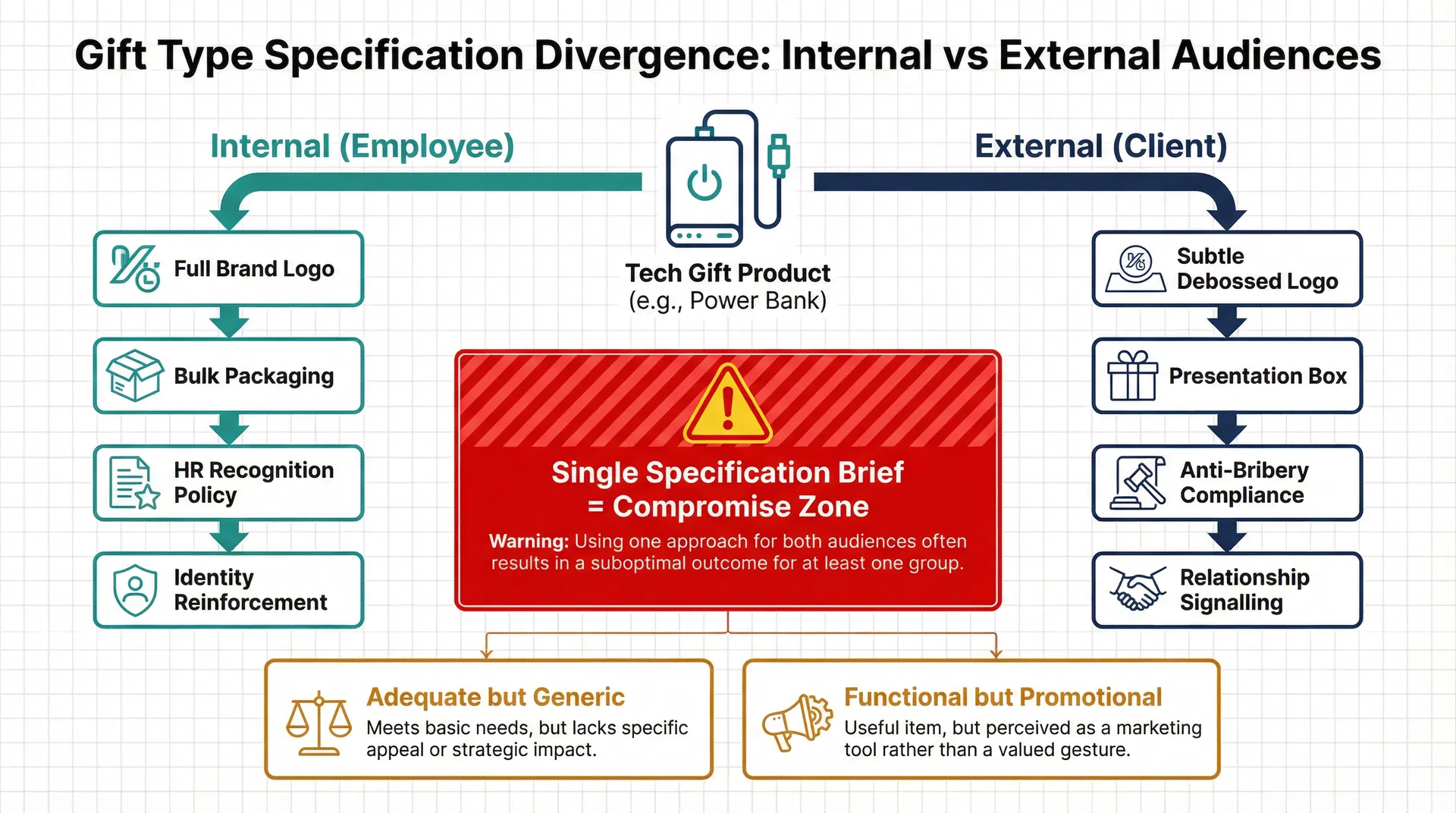
The practical consequence of ignoring this divergence is not dramatic—there is no single catastrophic failure. Instead, it manifests as a slow erosion of programme effectiveness. The employee gifts feel slightly generic because the specification was constrained by external compliance considerations. The client gifts feel slightly promotional because the branding was designed for internal identity reinforcement. Both audiences receive something adequate, and neither receives something that was actually designed for them. Over multiple gifting cycles, this adequacy gap compounds into a perception that the company's gifting programme is perfunctory rather than intentional.
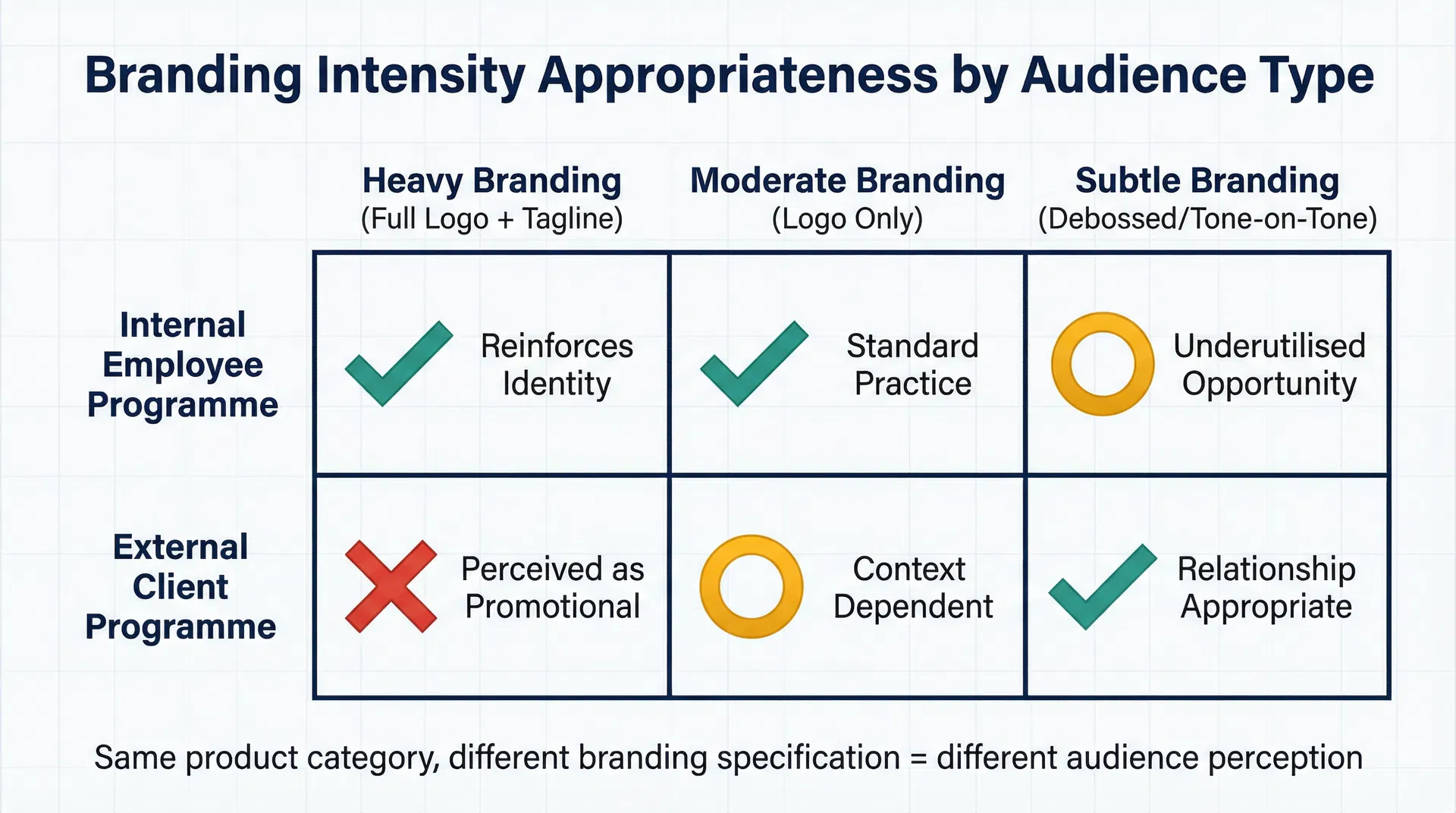
The correction is not expensive, but it requires a structural change in how the procurement brief is written. The brief needs to specify the audience before the product, the branding intensity before the logo file, and the compliance framework before the unit budget. When these parameters are established first, the gift type selection becomes a downstream decision that naturally produces appropriate specifications for each audience—even when the underlying product category remains the same.