How the Gift Type Escalation Trap Quietly Destroys Long-Term Corporate Tech Gifting Programmes in the UAE
Published · Written by Compliance Review Desk
Written by: Emirates Tech Works Compliance Review Desk
Reviewed by: Emirates Tech Works Procurement Editorial Team (Procurement scope review). This is an organisational review role, not an individual endorsement.
There is a pattern that becomes visible only when you manage the production side of a corporate gifting account over multiple cycles. The first order arrives with a clear brief: branded power banks, five hundred units, standard packaging, logo on the front face. The product ships, the client is satisfied, the relationship continues. Six months later, the reorder comes in, but this time the brief has shifted. The procurement contact explains that the previous gift was well received, but now they need something that feels like a step up. The budget has increased slightly, and the expectation is that the gift type should reflect the deepening relationship. So the order moves to wireless charging pads with premium packaging. Another cycle passes, and the request escalates again—this time to Bluetooth speakers with custom engraving and magnetic closure gift boxes.
From the production floor, this trajectory is immediately recognisable. It is the escalation pattern, and it is one of the most common structural failures in long-term corporate tech gifting programmes across the UAE market. The underlying assumption driving it is intuitive but fundamentally flawed: that as a business relationship matures, the gift type must increase in monetary value and product complexity to remain meaningful. This assumption treats the gifting programme as a ladder where each rung must be higher than the last, and it creates three predictable failure points that most procurement teams do not anticipate until the programme is already compromised.
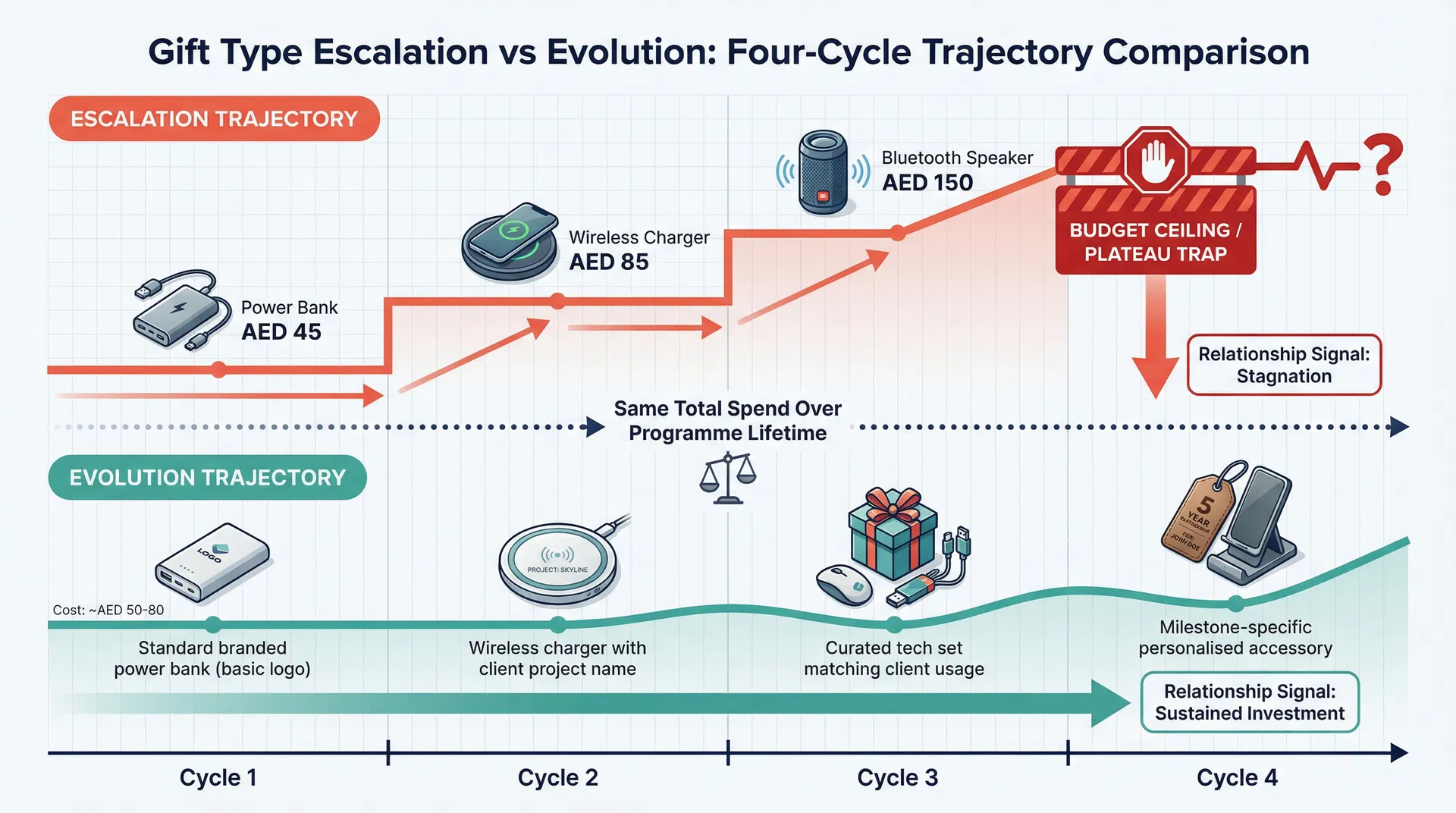
The first failure point is budget unsustainability. A programme that begins with AED 45 power banks and escalates through AED 85 wireless chargers to AED 150 speakers to AED 250 noise-cancelling earbuds reaches a ceiling within three to four cycles. At that point, the procurement team faces an impossible choice: continue escalating into a price range that finance will not approve for the recipient tier, or step back to a lower-value product and risk the perception that the relationship has been downgraded. Neither option serves the business objective. The escalation logic has created a structural trap where the programme cannot move forward or backward without sending an unintended signal.
The second failure point is what production teams see as specification drift. Each escalation cycle introduces new product categories with different manufacturing requirements, different lead times, different quality control parameters, and different customisation constraints. A power bank programme that has been running for two years has optimised tooling, established colour-matching standards, and built reliable quality benchmarks. When the brief shifts to Bluetooth speakers, all of that institutional knowledge resets. The new product category requires fresh sampling, new compliance testing, different packaging engineering, and a learning curve that inevitably introduces quality variance in the first production run. The procurement team experiences this as inconsistency; the production team recognises it as the natural consequence of abandoning a mature product line for an unfamiliar one.
The third failure point is the most damaging and the least visible. When escalation becomes unsustainable, procurement teams default to what they consider the safest option: they freeze on a single gift type—usually a mid-range tech accessory like a wireless charger or a portable speaker—and repeat it indefinitely. This plateau feels like stability from the procurement side, but from the recipient's perspective, it communicates something entirely different. A client who receives the same branded wireless charger from the same company for three consecutive gifting occasions does not interpret this as consistency. They interpret it as the point where the company stopped investing thought into the relationship. The gift has become administrative rather than relational.
The alternative to escalation is evolution, and the distinction matters enormously in how a gifting programme is structured from the production side. Evolution means that the gift type changes not in monetary value but in contextual relevance. A first-cycle branded power bank establishes the company's presence. A second-cycle wireless charger with the client's own project name subtly incorporated into the design demonstrates attention. A third-cycle tech accessory set curated specifically around the client's known usage patterns—perhaps a desk-mounted charging station paired with a cable management solution—shows that the gifting programme has matured alongside the relationship. The unit cost across these three cycles may remain within the same AED 50–80 range, but the perceived investment in the relationship increases with each iteration because the customisation depth and contextual specificity evolve.
From a production standpoint, evolution-based programmes are significantly more manageable than escalation-based ones. When the base product category remains within the same family—charging accessories, for instance—the factory maintains tooling continuity, quality benchmarks carry forward, and customisation capabilities deepen with each cycle rather than resetting. The production team can offer increasingly sophisticated personalisation options within the same product architecture: laser-etched patterns that reference previous collaborations, colour palettes that align with the client's brand evolution, packaging configurations that reflect the occasion rather than the price point. These refinements cost less to implement than category switches and deliver more relationship value per unit.
The practical discipline required is straightforward but rarely implemented. Instead of asking "what is a more expensive gift type than last time," the procurement brief should ask "what does this specific recipient need from this specific gifting moment that is different from the last one." This reframes the gift type decision from a value ladder to a relevance matrix. A three-year client entering a contract renewal period needs a gift that acknowledges the partnership's history, not a gift that costs more than last year's. A client who has just expanded into a new market needs a gift that reflects awareness of that milestone, not a product upgrade from the previous category. The organisations that manage corporate gift type selection across different business contexts most effectively are those that build their programmes around relationship milestones rather than price increments.
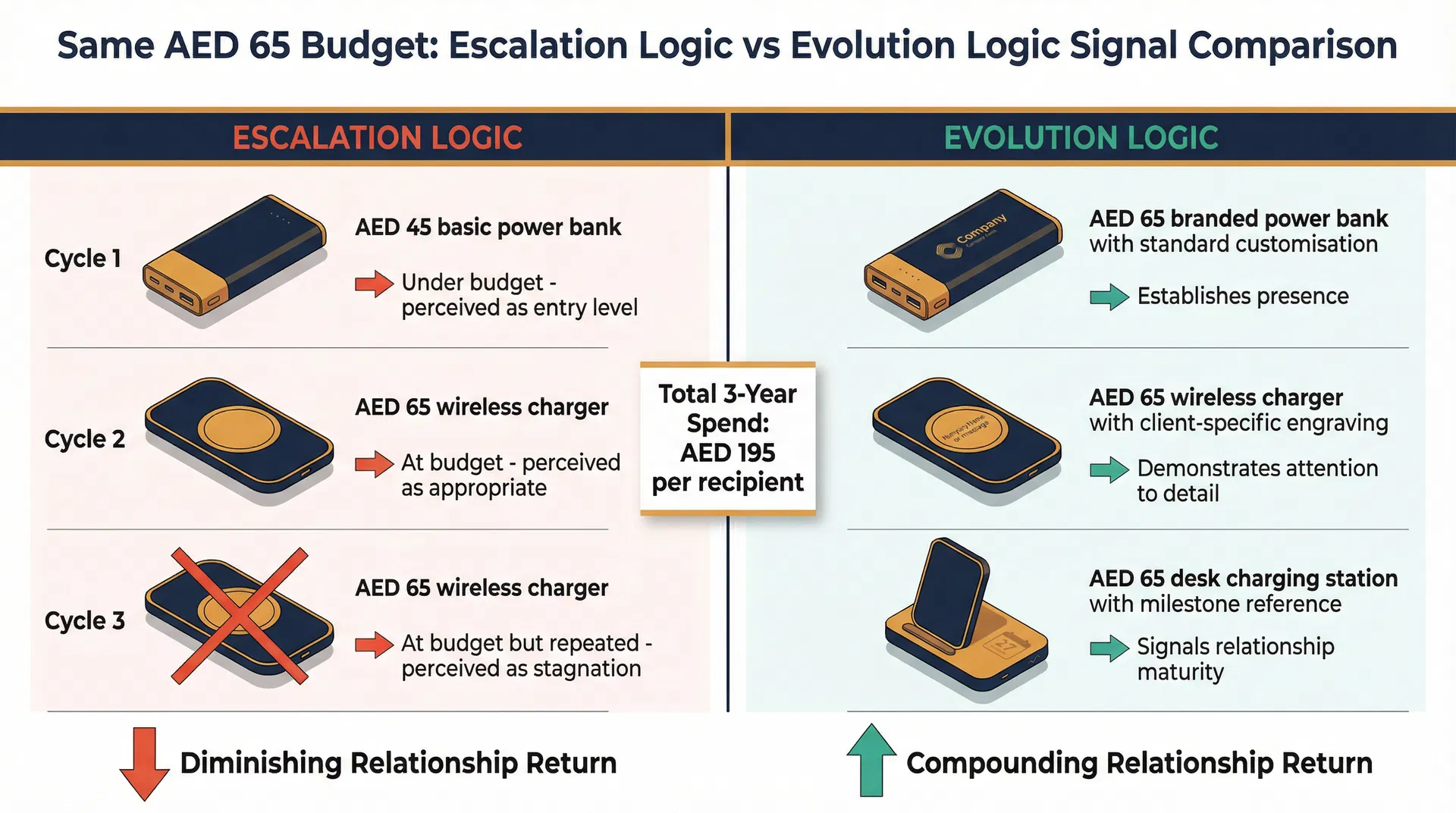
The escalation trap is particularly acute in the UAE market because business relationships here carry a longer memory than in many other commercial environments. A client in Dubai or Abu Dhabi who has received gifts from the same company over five or six cycles has a detailed mental record of the trajectory. If that trajectory shows escalation followed by plateau, the narrative it creates is one of initial enthusiasm that faded into routine. If the trajectory shows consistent evolution in relevance and personalisation, the narrative is one of sustained investment in the relationship's specific character. Both trajectories may involve identical total expenditure over the programme's lifetime, but the relational return diverges dramatically. The production records tell the same story: escalation programmes generate increasingly complex briefs with diminishing satisfaction, while evolution programmes generate increasingly specific briefs with compounding trust.