When Corporate Tech Gift Type Decisions Get Locked Too Early in the UAE Procurement Cycle — and Why Late Corrections Cost More Than Starting Over
Published · Written by Compliance Review Desk
Written by: Emirates Tech Works Compliance Review Desk
Reviewed by: Emirates Tech Works Procurement Editorial Team (Procurement scope review). This is an organisational review role, not an individual endorsement.
There is a pattern that repeats across nearly every corporate gifting programme we review in the Gulf region, and it has nothing to do with choosing the wrong product. The gift type itself — whether it is a branded power bank, a wireless charging pad, or a Bluetooth speaker set — is usually defensible. The problem is when that decision gets finalised within the procurement workflow. In practice, the timing of the gift type commitment is where most programmes begin to quietly fail, long before anyone notices the consequences at delivery.
Most procurement teams in the UAE operate under compressed timelines. A corporate gifting brief lands on the desk in late Q3, and by the time internal stakeholders have debated branding guidelines, recipient lists, and budget thresholds, the window for production has already narrowed. Under that pressure, the gift type decision gets pushed forward — locked in before the recipient segmentation is complete, before compliance checks against specific industry sectors are finished, and sometimes before the supplier has confirmed that the chosen product can actually be produced at the required specification and volume within the remaining lead time.
This early lock creates a cascade of downstream constraints that are rarely visible at the approval stage. Once a gift type is committed, the factory begins tooling, sourcing components, and scheduling production slots. Changing the product category after that point — shifting from a power bank to a wireless charger, for example — does not simply mean updating a line item on a purchase order. It means restarting the sample approval process, renegotiating component sourcing, and potentially losing the production slot entirely. The cost of a late category change in a UAE corporate gifting programme is not just financial; it is temporal. And in a market where delivery windows are often tied to specific events — Ramadan, National Day, GITEX, annual board meetings — losing two weeks to a category reset can mean missing the occasion altogether.
The opposite failure mode is equally damaging but less discussed. Some procurement teams, aware of the risks of premature commitment, delay the gift type decision until all recipient data, compliance approvals, and budget confirmations are in place. This sounds prudent, but it compresses the production timeline to a point where only the most generic, readily available products can be fulfilled. The programme ends up with whatever the supplier has in stock rather than what the business need actually requires. The irony is that the caution intended to improve the outcome produces exactly the kind of undifferentiated, forgettable gift that the programme was designed to avoid.
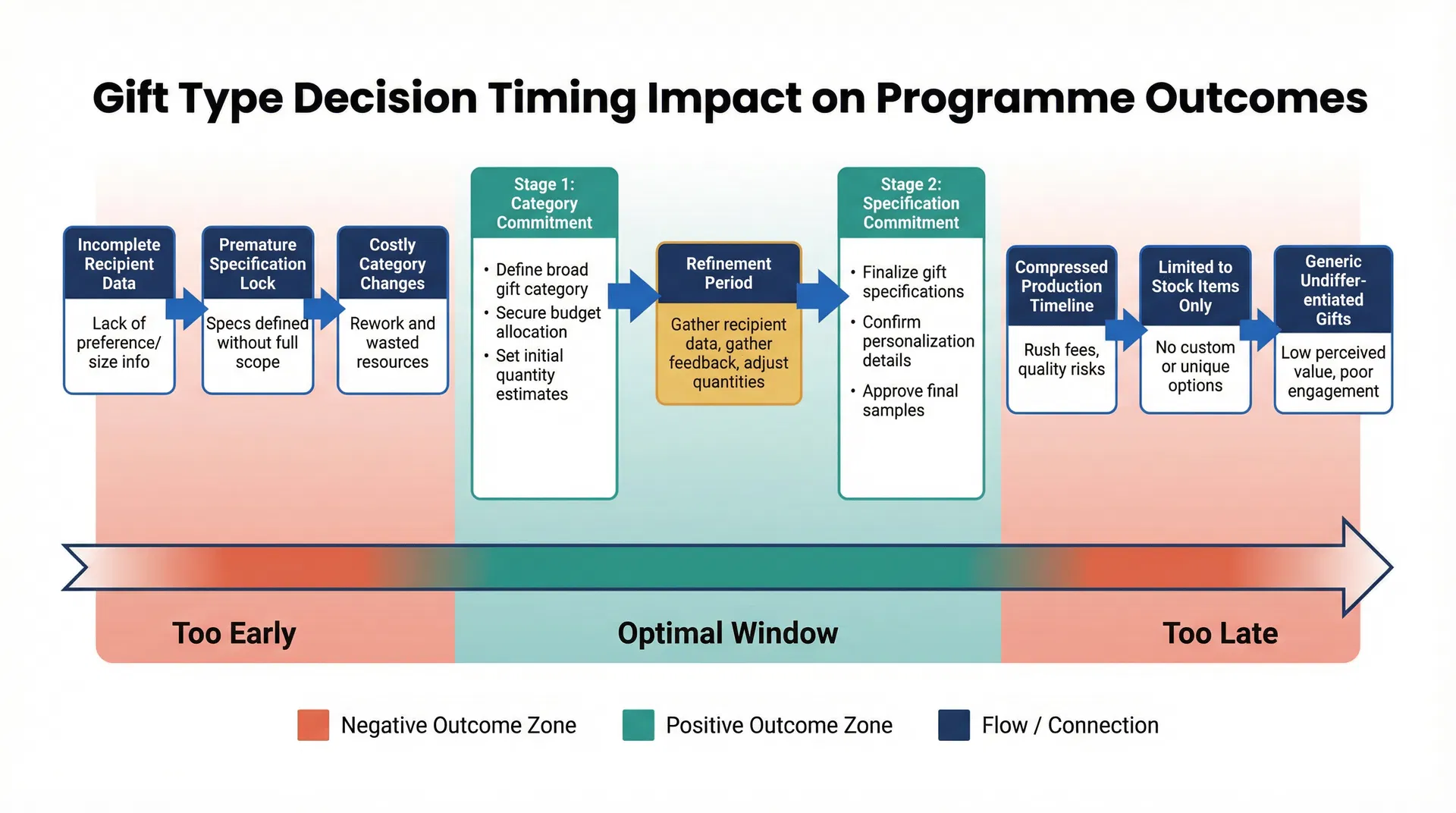
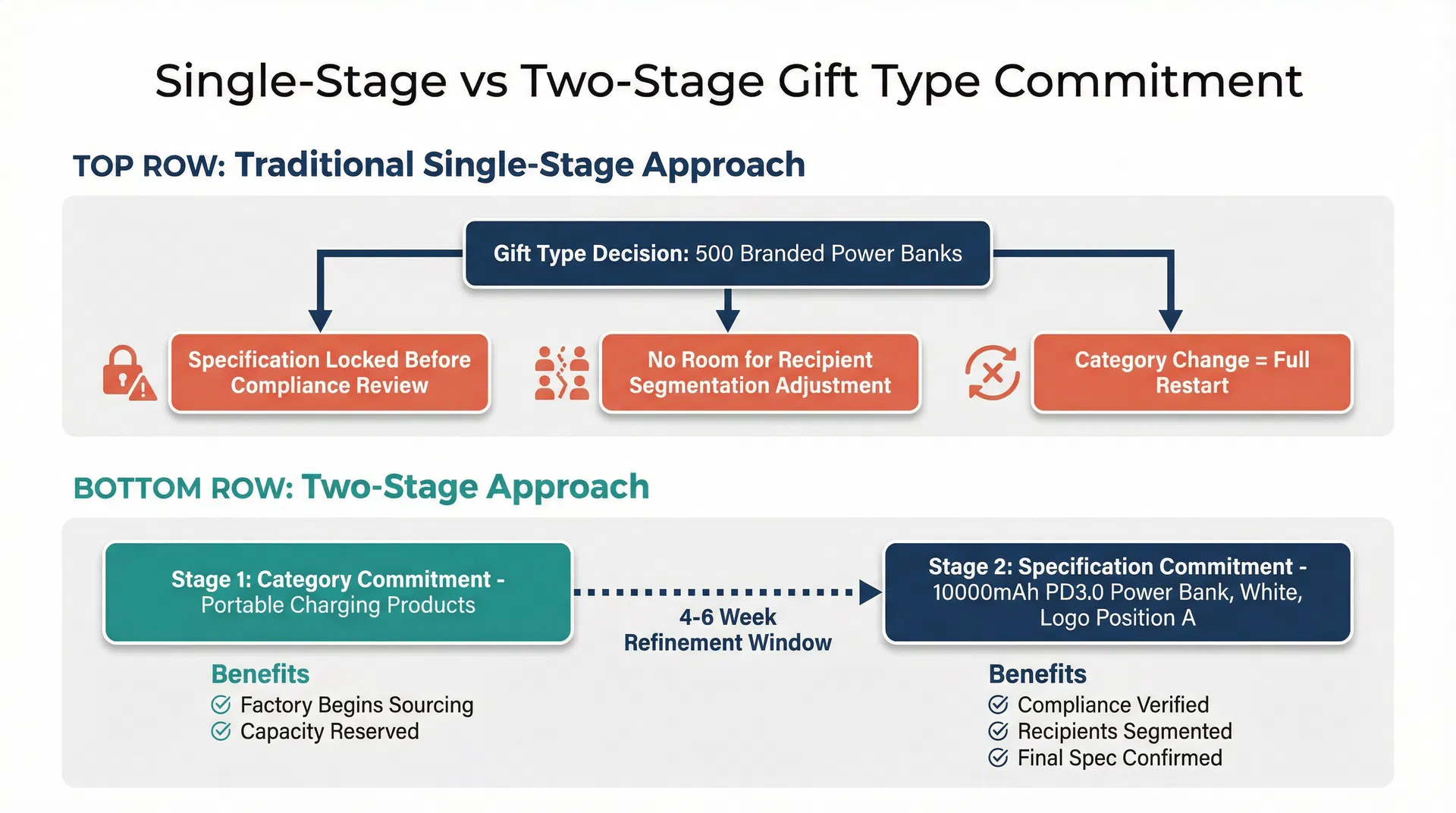
The practical resolution is not to find the perfect moment — there is no universal answer — but to separate the gift type decision into two distinct commitments. The first is a category commitment: the broad product family (portable electronics, audio accessories, desktop tech) that aligns with the programme's objectives and the recipient profile. This can and should be made early, because it allows the factory to begin preliminary sourcing and capacity planning without locking in the exact specification. The second is a specification commitment: the precise model, capacity, colour, branding placement, and packaging configuration. This should be deferred until recipient segmentation and compliance review are substantially complete.
This two-stage approach is not standard practice in most UAE corporate gifting workflows. The typical procurement brief treats the gift type as a single decision point — "we want 500 branded power banks" — without distinguishing between the category selection and the specification detail. That conflation is where the timing problem originates. A category commitment of "portable charging products" gives the factory enough direction to hold capacity and begin component sourcing, while leaving room for the specification to be refined as the programme's requirements crystallise. For organisations navigating the broader question of which gift types align with different business contexts, this staging approach adds a procedural layer that most selection frameworks do not address.
The risk profile also shifts depending on the gift type category itself. Tech accessories with rapidly evolving specifications — USB-C power delivery standards, wireless charging wattage ratings, Bluetooth codec versions — carry higher obsolescence risk when the specification is locked early. A power bank specified in January with a particular charging protocol may be technically outdated by the time it ships in September. Non-electronic gift types do not carry this risk, but they introduce different timing sensitivities around seasonal relevance and cultural appropriateness. The point is that the optimal decision timing is not uniform across all gift categories, and treating it as such is one of the more common structural errors in corporate gifting procurement.
What makes this particularly difficult to correct is that the consequences of poor timing are often attributed to other causes. A gift that arrives late gets blamed on logistics. A gift that feels generic gets blamed on the selection committee's lack of creativity. A gift that triggers a compliance rejection gets blamed on the legal team's late involvement. In each case, the actual root cause may be that the gift type was committed at the wrong point in the workflow — either before the information needed to make a sound decision was available, or after the production timeline could accommodate anything beyond a default option. Until procurement teams begin treating the timing of the gift type decision as a distinct variable — separate from the type itself — these patterns will continue to repeat across programme cycles without being properly diagnosed.