Why Ordering the Same Tech Gift Type for Every Business Occasion Quietly Erodes Your UAE Corporate Gifting Programme's Credibility
Published · Written by Compliance Review Desk
Written by: Emirates Tech Works Compliance Review Desk
Reviewed by: Emirates Tech Works Procurement Editorial Team (Procurement scope review). This is an organisational review role, not an individual endorsement.
There is a pattern in corporate tech gift procurement across the UAE that looks efficient on paper but creates compounding problems in practice. A procurement team identifies a product category—wireless chargers, for instance—that performed well in one context. The unit cost is reasonable, the supplier relationship is established, the compliance documentation is already filed, and the product passed quality inspection on the first order. So the team reorders the same category for the next occasion. And the next. Within two fiscal quarters, the same wireless charger—or a marginally different variant of it—has been distributed to new clients during onboarding, to existing partners during Ramadan, to internal teams during a company milestone, and to prospects at a trade exhibition. The procurement dashboard shows cost efficiency improving with each order. What it does not show is the accelerating erosion of gift impact across every recipient segment.
This is where corporate gift type decisions begin to be misjudged in ways that quality and compliance reviews rarely catch, because the metrics that flag problems—recipient perception, brand differentiation, relationship-stage appropriateness—are not captured in standard procurement reporting. The product itself may be flawless. Every unit passes inspection. Packaging meets specification. Delivery timelines are met. From a quality control perspective, the programme appears to be functioning well. But the programme's strategic effectiveness is declining with each repeated deployment of the same gift category, and the decline is invisible until a client mentions—usually indirectly—that they received the same type of item from your company three times in eighteen months.
The consolidation instinct is understandable. When a procurement team manages corporate gifting alongside dozens of other sourcing responsibilities, reducing the number of product categories in rotation simplifies every downstream process. Supplier qualification happens once instead of repeatedly. Quality benchmarks are established and stable. Customs documentation for UAE imports follows a proven template. Internal approval workflows move faster because stakeholders have already signed off on the product type. The operational logic is sound. The strategic logic is not.
The problem is structural: different business occasions carry different relationship signals, and when the same gift type appears across occasions that carry fundamentally different meanings, the gift stops communicating anything specific. A branded power bank given during client onboarding signals practical welcome—here is something useful as we begin working together. The same branded power bank given during a Ramadan appreciation gesture signals something entirely different—or rather, it fails to signal anything at all, because the recipient recognises it as the same category they received six months ago. The gift has become administrative rather than communicative. It tells the recipient that the gifting programme runs on autopilot rather than intention.
In practice, this consolidation creates three distinct risk layers that compound over time. The first is perception fatigue within your recipient ecosystem. UAE business culture places significant weight on the thoughtfulness embedded in gift exchanges, particularly during religious and cultural occasions. When a recipient receives the same type of tech product across multiple touchpoints—even if the specific model varies slightly—the cumulative impression shifts from appreciation to routine. The gift becomes expected rather than meaningful, and expected gifts carry no relational currency.
The second risk layer involves compliance documentation that appears robust but masks strategic misalignment. When a company files gift declarations—particularly for government-adjacent or semi-government clients in the UAE, where gift value thresholds and appropriateness standards are closely monitored—a pattern of identical gift types across multiple occasions can raise questions that varied gift categories would not. A compliance reviewer seeing four entries of "wireless charging device, AED 85" distributed to the same entity across different quarters may interpret the pattern differently than four entries showing contextually appropriate variety: a tech organiser for onboarding, a premium desk accessory for Ramadan, a branded speaker set for a project completion milestone, and a wireless charger for a trade event. The varied pattern demonstrates intentional, occasion-specific selection. The consolidated pattern suggests systematic distribution that may warrant closer scrutiny.
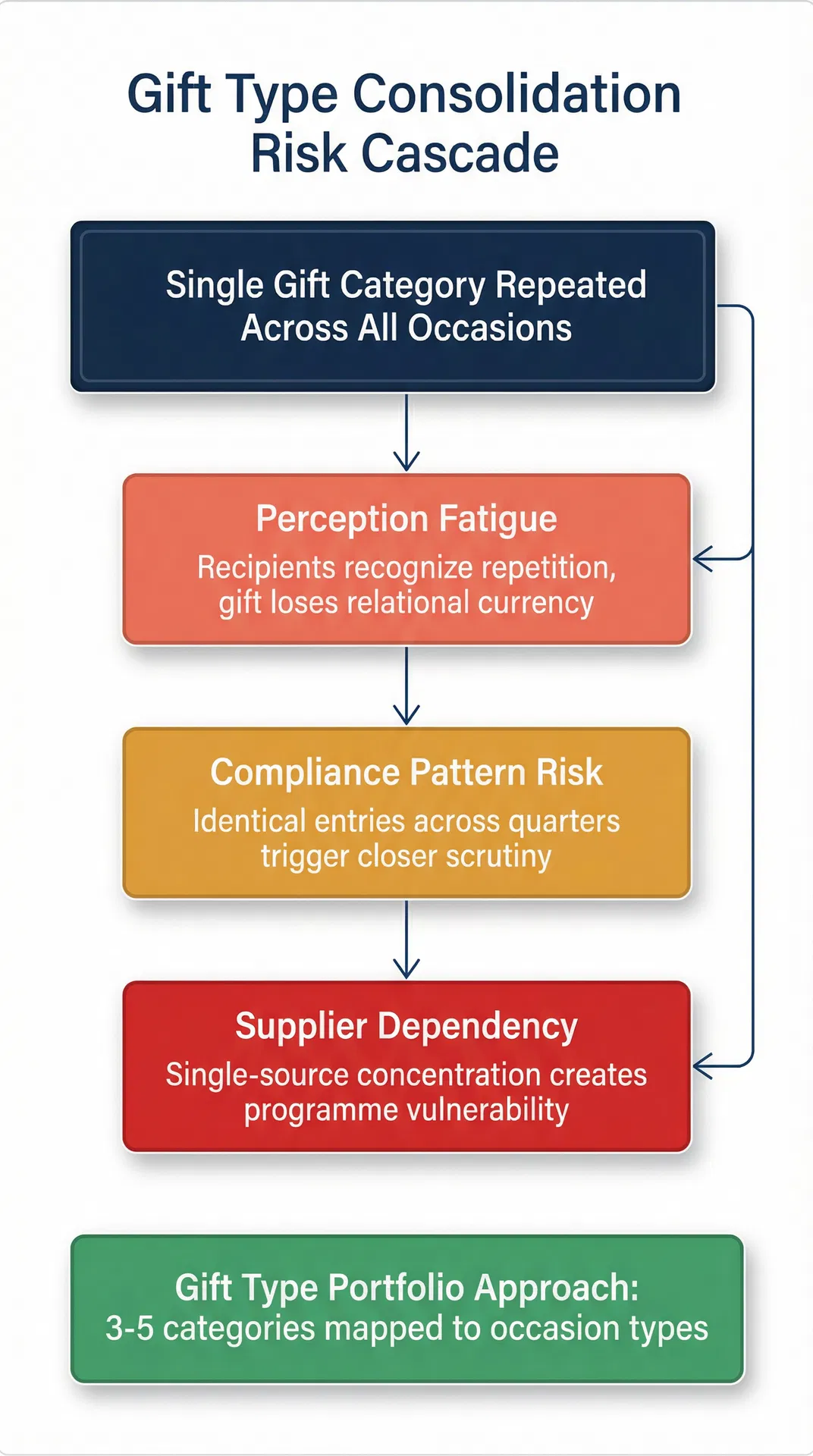
The third risk layer is the most operationally tangible: supplier dependency that reduces negotiating flexibility. When a procurement programme concentrates its entire gifting volume into a single product category from a single supplier, the apparent cost efficiency creates hidden vulnerability. If that supplier experiences production delays, quality issues, or capacity constraints—all common occurrences in consumer electronics manufacturing—the entire gifting programme stalls. Diversifying across three or four product categories with two or three qualified suppliers creates operational resilience that consolidated programmes lack. The unit cost may be marginally higher, but the programme's ability to deliver on time across all business occasions is substantially more robust.
The resolution is not to abandon category efficiency entirely, but to establish what might be called a "gift type portfolio" approach—maintaining a curated rotation of three to five tech product categories, each mapped to specific business occasion types. Onboarding occasions draw from one category set (practical, daily-use items like USB hubs or tech organisers). Relationship milestone occasions draw from another (premium, presentation-focused items like custom desk accessories or branded wireless charging stations with enhanced packaging). Cultural and religious occasions draw from a third (items selected for their appropriateness to the specific occasion, with packaging and presentation adapted accordingly). Trade and exhibition occasions draw from a fourth (portable, high-visibility items optimised for brand exposure).
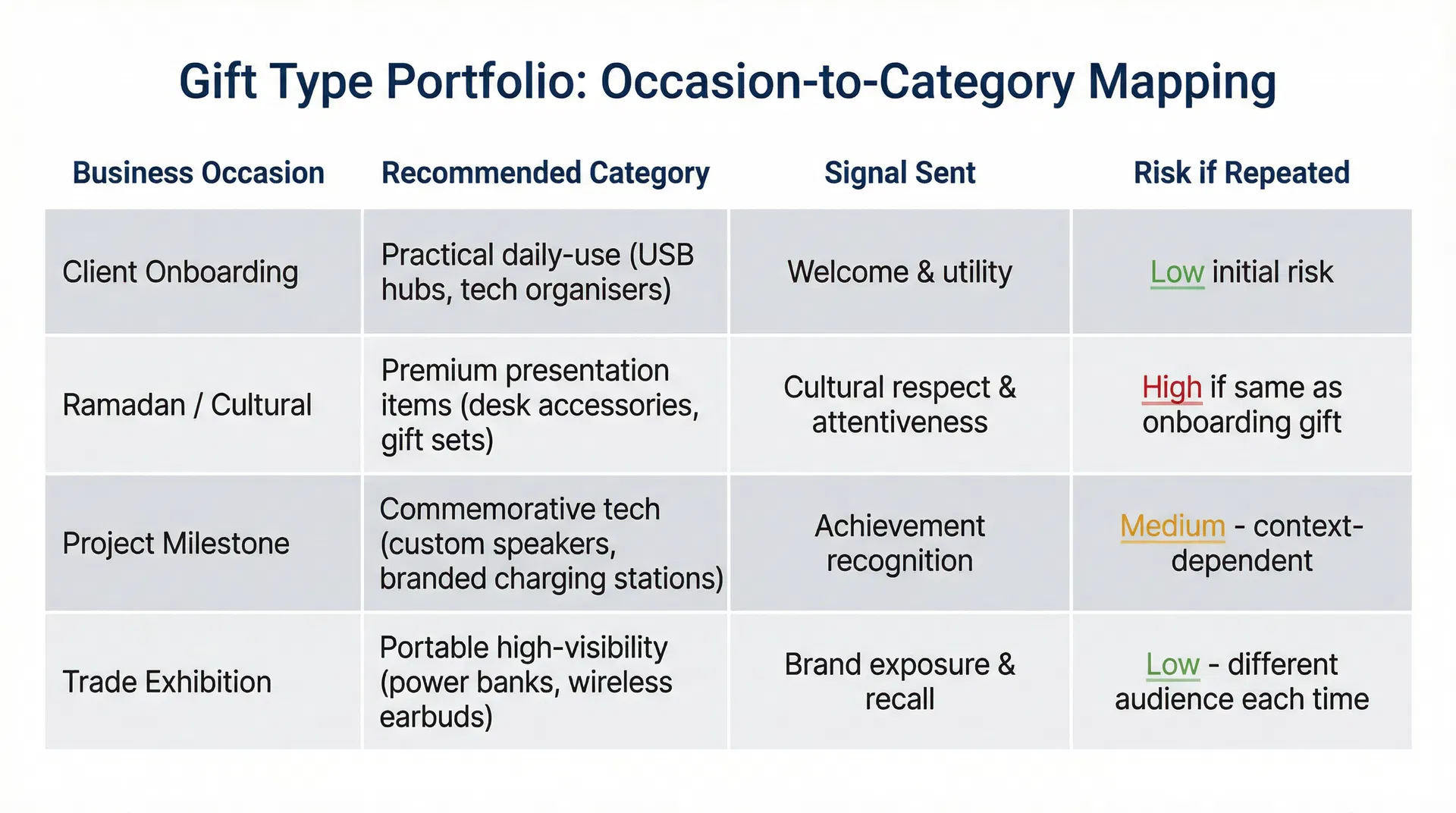
This portfolio approach requires marginally more procurement effort upfront—qualifying additional suppliers, establishing quality benchmarks for multiple product categories, creating occasion-specific packaging specifications. But it eliminates the compounding perception problem that single-category consolidation creates. Each gift type appears in its appropriate context, reinforcing the message that the gifting programme operates with intention rather than convenience.
Understanding which gift categories align with specific business contexts is the foundational step, but the implementation discipline—maintaining category diversity across occasions rather than defaulting to the most operationally convenient option—is where most UAE corporate gifting programmes lose strategic value. The procurement team that orders 1,000 units of one product type at a lower unit cost may report better numbers than the team that orders 300 units across three categories at a slightly higher per-unit price. But the second team's programme will generate measurably stronger recipient engagement over twelve months, because each gift carries contextual relevance that repetition cannot replicate.
The most telling indicator that a gifting programme has over-consolidated is when internal stakeholders stop reviewing gift selections for upcoming occasions and simply approve the reorder. When the gift type decision becomes automatic rather than deliberate, the programme has shifted from strategic communication to administrative fulfilment. And in a market like the UAE, where business relationships are built on demonstrated attentiveness and cultural awareness, that shift carries consequences that no volume discount can offset.