Why Your Minor Logo Adjustment Request Requires Five More Days Even Though Production Hasn't Started for UAE Corporate Tech Gifts
Published · Updated · Written by Product & Production Review Desk
Written by: Emirates Tech Works Product & Production Review Desk
Reviewed by: Emirates Tech Works Procurement Editorial Team (Procurement relevance review). This is an organisational review role, not an individual endorsement.
!Procurement vs Production revision authority and freeze window timeline comparison Procurement teams operate in an environment where specifications are managed as living documents subject to version control. A specification begins as draft v0.1, progresses through internal review to become v0.5, receives stakeholder input to reach v0.9, and is finalized as v1.0 upon approval. In this paradigm, revisions are not only normal but expected—the entire procurement workflow is designed to accommodate iterative refinement up until the moment of final approval. When a specification reaches v1.0 and is transmitted to the supplier, procurement assumes that "final approval" means "ready for production," and any changes requested after v1.0 but before production starts are treated as v1.1 revisions: minor, manageable, and well within the acceptable bounds of normal business practice.

Production planning, however, operates in a parameter lock-in paradigm where specifications are not documents to be revised but blueprints to be translated into executable manufacturing parameters. Once a customization specification is received, production planning begins a multi-stage process of parameter definition that includes material procurement, tooling configuration, quality control criteria establishment, and packaging artwork finalization. Each of these stages builds upon the previous one, and each stage requires coordination across multiple functions within the factory and, in many cases, back to the customer for clarification or approval. This parameter definition process is not instantaneous—it typically requires five to eight days depending on the complexity of the customization—and once it begins, any change to the original specification triggers a cascade of re-validation work that effectively restarts the entire process.
Consider a concrete scenario that illustrates how this gap manifests in practice. A UAE corporate client orders 5,000 custom wireless power banks with their company logo laser-engraved on the top surface. The procurement team finalizes the specification on day 1: product model (10,000mAh aluminum power bank), customization method (laser engraving), logo file (vector AI provided), logo position (centered on top surface, 15mm from the top edge), engraving depth (0.3mm), quantity (5,000 units), delivery date (40 days from order). The specification is approved internally on day 3, and the purchase order is issued to the supplier on day 5. Production is scheduled to begin on day 15, giving the factory ten days to complete parameter definition and line setup.
On day 6, the factory's production planning team receives the specification and begins the parameter definition process. The first task is to translate the logo position specification—"centered on top surface, 15mm from the top edge"—into laser engraving machine coordinates. This requires the equipment team to load the product CAD file, overlay the logo artwork, calculate the exact X-Y coordinates for the laser focal point, and generate a machine program that positions the laser head correctly for each unit. This work takes one day because the equipment team must also account for product surface curvature (the power bank top surface is slightly rounded, not flat) and determine whether the logo needs to be distorted slightly to appear visually centered when viewed from above. On day 7, the equipment team runs test engravings on sample units to verify that the logo appears in the correct position and that the engraving depth is consistent across the entire logo area. On day 8, the quality assurance team uses the test-engraved samples to establish inspection criteria: what is the acceptable tolerance for logo position variation? If the logo is 0.5mm off-center due to product surface variation, is that a defect or within tolerance? Quality assurance defines measurable criteria and prepares inspection templates that will be used during production. On day 9, the packaging team receives the logo artwork and begins preparing the gift box design, which will feature the same logo on the box lid. The packaging team sends artwork mockups to the customer's branding team for approval.
On day 10, while the packaging team is waiting for branding approval and the factory is preparing to lock in the production parameters, the procurement team sends an email: "Please adjust the logo position to 17mm from the top edge instead of 15mm. Our marketing team reviewed the mockup and prefers a slightly lower placement." From the procurement perspective, this is a minor v1.1 revision—the logo is still centered, still laser-engraved, still the same size and depth; only the vertical position has changed by two millimeters. The request is submitted five days before production is scheduled to start, well within what procurement considers a reasonable revision window. The expectation is that the factory will acknowledge the change, update the specification document, and proceed with production on day 15 as originally planned.
From the production planning perspective, however, this request is not a v1.1 revision but a complete restart of the parameter definition process. The laser engraving machine coordinates that were calculated on day 6 are now invalid and must be recalculated. The test engravings that were run on day 7 are now invalid and must be re-run with the new logo position. The quality inspection criteria that were established on day 8 are now invalid because the acceptable tolerance for logo position variation may be different at 17mm from the edge versus 15mm from the edge (surface curvature may affect engraving consistency differently at different vertical positions). The packaging artwork mockups that were sent to the customer's branding team on day 9 are now invalid because the logo position on the gift box lid must match the logo position on the power bank itself, and the branding team's approval was based on the 15mm placement, not the 17mm placement.
!Cascade effect of specification change during parameter definition process
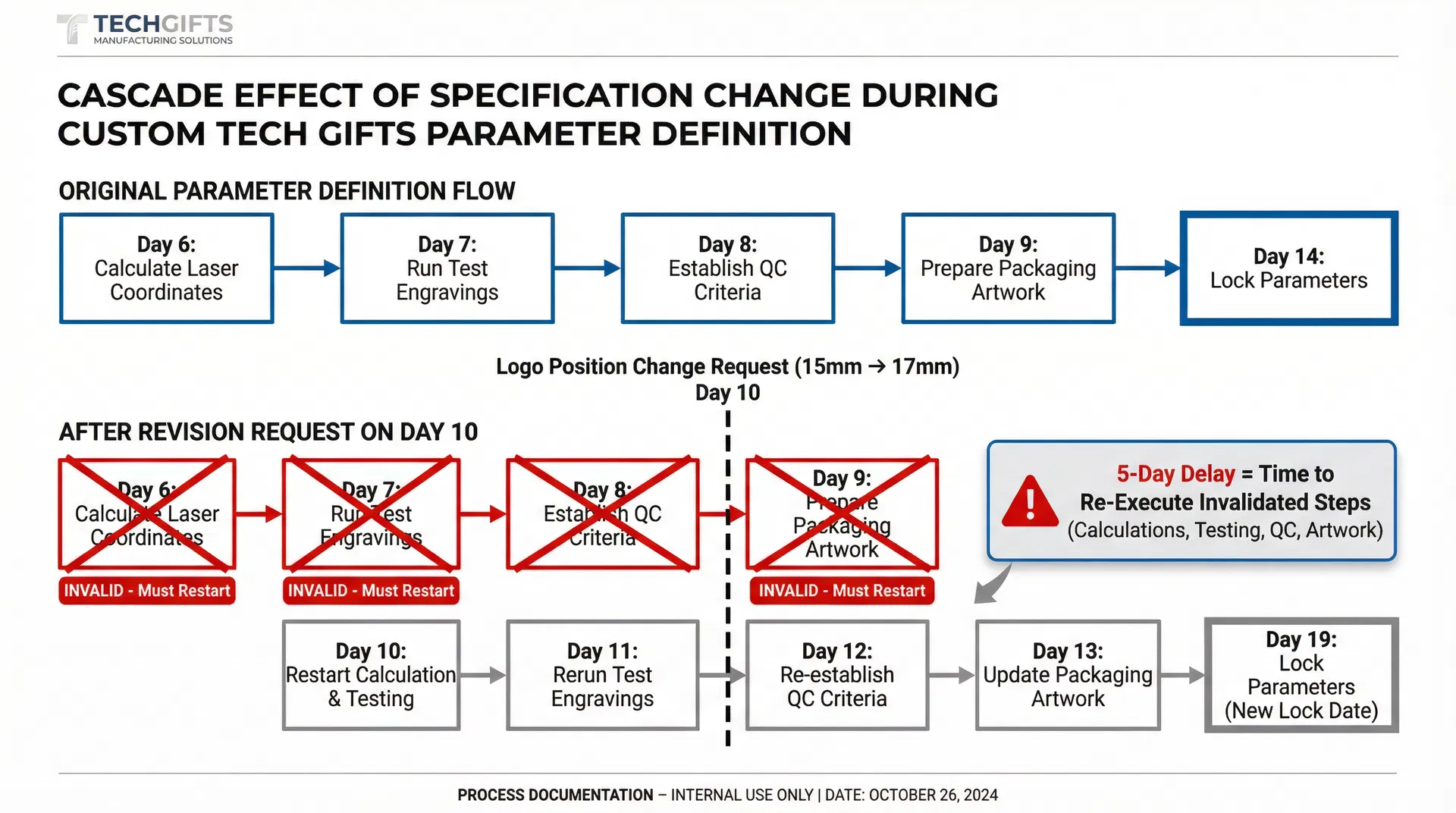
Restarting the parameter definition process requires five days: one day to recalculate machine coordinates, one day to run new test engravings, one day to re-establish quality inspection criteria, one day to revise packaging artwork and re-submit to the branding team for approval, and one day of buffer to account for any unexpected issues that arise during re-validation. This means that production, which was originally scheduled to start on day 15, cannot begin until day 20 at the earliest. The factory communicates this timeline to the procurement team on day 10: "We can accommodate the logo position change, but it will require five additional days to re-validate all production parameters."
The procurement team's reaction is often one of frustration and disbelief. The factory confirmed on day 6 that production would start on day 15, which is still five days away. The change request was submitted with five days of lead time, not at the last minute. The change itself is objectively minor—two millimeters, not a fundamental redesign. How can a two-millimeter adjustment require five days of additional work when production hasn't even started yet? From procurement's vantage point, the factory's response appears to be either an excuse to cover up internal inefficiency ("they should have built more flexibility into their planning") or an attempt to extract additional fees ("they're using this as leverage to charge us for rush processing").
In reality, the five-day delay is caused by the structural difference between procurement's revision authority and production's freeze window. Procurement assumes that revision authority extends up until the moment production starts, because in the document revision paradigm, changes can be made to a specification as long as it hasn't been executed yet. Production, however, requires a freeze window—a period of time before production starts during which no changes are accepted—because in the parameter lock-in paradigm, execution begins not when the production line starts but when parameter definition begins. The freeze window for this power bank order was day 6 to day 14: once production planning began translating the specification into manufacturing parameters on day 6, any change to the specification would require restarting the translation process, and the factory needed at least one day (day 14) to complete final line setup after all parameters were locked in.
The procurement team's revision request on day 10 fell within the freeze window, even though it was submitted five days before the scheduled production start date. From production's perspective, the freeze window had already been in effect for four days by the time the revision request arrived, and accepting the change would require unwinding four days of completed parameter definition work and restarting from day 6. The five-day delay is not a penalty or an excuse—it is the minimum time required to re-execute the parameter definition process that was originally completed between day 6 and day 14.
This blind spot is amplified by the fact that procurement teams rarely see the parameter definition process. From their vantage point, the specification was submitted on day 5, production is scheduled to start on day 15, and the intervening ten days are a "black box" during which the factory is presumably preparing materials and setting up equipment. The factory does not typically send daily updates saying "we calculated laser coordinates today" or "we ran test engravings today" because these activities are considered internal production planning work rather than customer-facing milestones. As a result, procurement only becomes aware of the parameter definition timeline when they submit a revision request and receive a response explaining why the change cannot be accommodated without restarting the process. By that point, the perception has already formed that the factory is "inflexible" or "making excuses" rather than "operating within the constraints of the parameter lock-in paradigm."
The consequences of this misjudgment extend beyond a single delayed order. First, the timeline cost: if the corporate event for which the power banks were intended occurs on day 45, and the power banks now arrive on day 50 due to the revision delay, the gifts miss the event entirely and lose their intended impact. Second, the relationship cost: procurement believes they submitted a reasonable revision request with adequate lead time, yet the supplier "refused to accommodate a minor change," and this perception erodes trust and makes future collaboration more cautious. Third, the internal cost: procurement must explain the delay to internal stakeholders—marketing, executive leadership, event planning—and may face scrutiny about why they didn't anticipate that a "two-millimeter logo adjustment" would cause a five-day delay, even though the specification template and purchase order terms provided no indication that revision authority expired before production started.
The misjudgment persists because procurement and production operate with different definitions of when "production" begins. Procurement defines production as "when the line starts running and units begin to be manufactured." Production defines production as "when parameter definition begins and the specification is translated into executable manufacturing instructions." The gap between these two definitions is the freeze window, and this gap is invisible to procurement unless the factory explicitly communicates when parameter definition begins and when the freeze window takes effect. In practice, most factories do not communicate this information proactively because they assume that procurement understands the parameter definition process and the need for a freeze window. Procurement, in turn, assumes that revision authority extends up until the line starts running because they have no visibility into the parameter definition process and no reason to believe that "production" begins before the line starts running.
The structural solution to this misjudgment is not to eliminate the freeze window—production genuinely requires a period of time during which no changes are accepted in order to complete parameter definition without constant restarts—but to make the freeze window visible and explicit in the specification and purchase order process. Understanding these timing constraints is part of managing the broader customization workflow effectively. Instead of stating "production will begin on day 15," the factory could state "parameter definition will begin on day 6, the freeze window will take effect on day 6, and production will begin on day 15." This would give procurement a clear understanding of when revision authority expires (day 6, not day 15) and how much lead time is required for any changes (submitted before day 6 to avoid restarting the parameter definition process). Without this visibility, procurement will continue to submit revision requests that fall within the freeze window, and production will continue to respond with timelines that procurement perceives as unreasonable, and the cycle of misjudgment and mistrust will perpetuate.