Why Choosing Culturally Neutral Tech Gifts for Ramadan and National Day Programmes in the UAE Communicates the Opposite of What Procurement Teams Intend
Published · Updated · Written by Compliance Review Desk
Written by: Emirates Tech Works Compliance Review Desk
Reviewed by: Emirates Tech Works Procurement Editorial Team (Procurement scope review). This is an organisational review role, not an individual endorsement.
There is a procurement logic that surfaces reliably every year around the same time. As Ramadan approaches, or as UAE National Day planning begins, the gifting brief lands on the procurement desk with a note that essentially reads: keep it safe, keep it professional, avoid anything that could be misinterpreted. The response, almost universally, is to select a tech product—a wireless charger, a Bluetooth speaker, a branded power bank—that the team considers culturally neutral. The reasoning is straightforward: technology carries no religious connotation, no dietary restriction, no risk of inadvertent offence. It is the procurement equivalent of a diplomatic handshake. And in most internal reviews, this decision passes without challenge.
The problem is that cultural neutrality, when applied to culturally significant occasions, does not register as respectful caution. It registers as indifference. This is one of the more persistent misjudgments in corporate gift type selection for the UAE market, and it is difficult to surface because the decision appears rational at every internal checkpoint. The product is appropriate. The budget is within policy. The supplier is qualified. The packaging is professional. Nothing in the standard procurement review framework flags the issue, because the issue is not with the gift itself—it is with the relationship between the gift type and the occasion it is meant to honour.
When a company sends a branded wireless charging pad during Ramadan to a government client in Abu Dhabi, the product functions perfectly well as a corporate gift in a generic context. But Ramadan is not a generic context. It is a period defined by spiritual reflection, generosity, and communal connection. The cultural expectation during Ramadan gifting is that the gift demonstrates awareness of these values—not necessarily through religious items, but through selections that acknowledge the occasion's significance. A premium date set with custom packaging, a curated wellness collection designed for the fasting period, or even a high-quality tech product paired with culturally resonant presentation all communicate engagement with the moment. A standard-issue branded gadget in a corporate box communicates that the procurement team treated Ramadan as another line item on the quarterly gifting schedule.
The same dynamic applies to UAE National Day. Companies that distribute the same tech accessory they use for trade exhibitions and client onboarding during National Day celebrations miss the opportunity to demonstrate that they understand the occasion's significance to their Emirati business partners. National Day is not a corporate milestone—it is a national identity moment. The gift type should reflect that distinction, even if the product category remains within the technology space. A custom-designed tech accessory incorporating UAE heritage colours, a premium device presented in packaging that references the occasion, or a curated tech gift set assembled specifically for the celebration all signal intentional engagement. The default wireless charger in standard corporate packaging signals operational convenience.
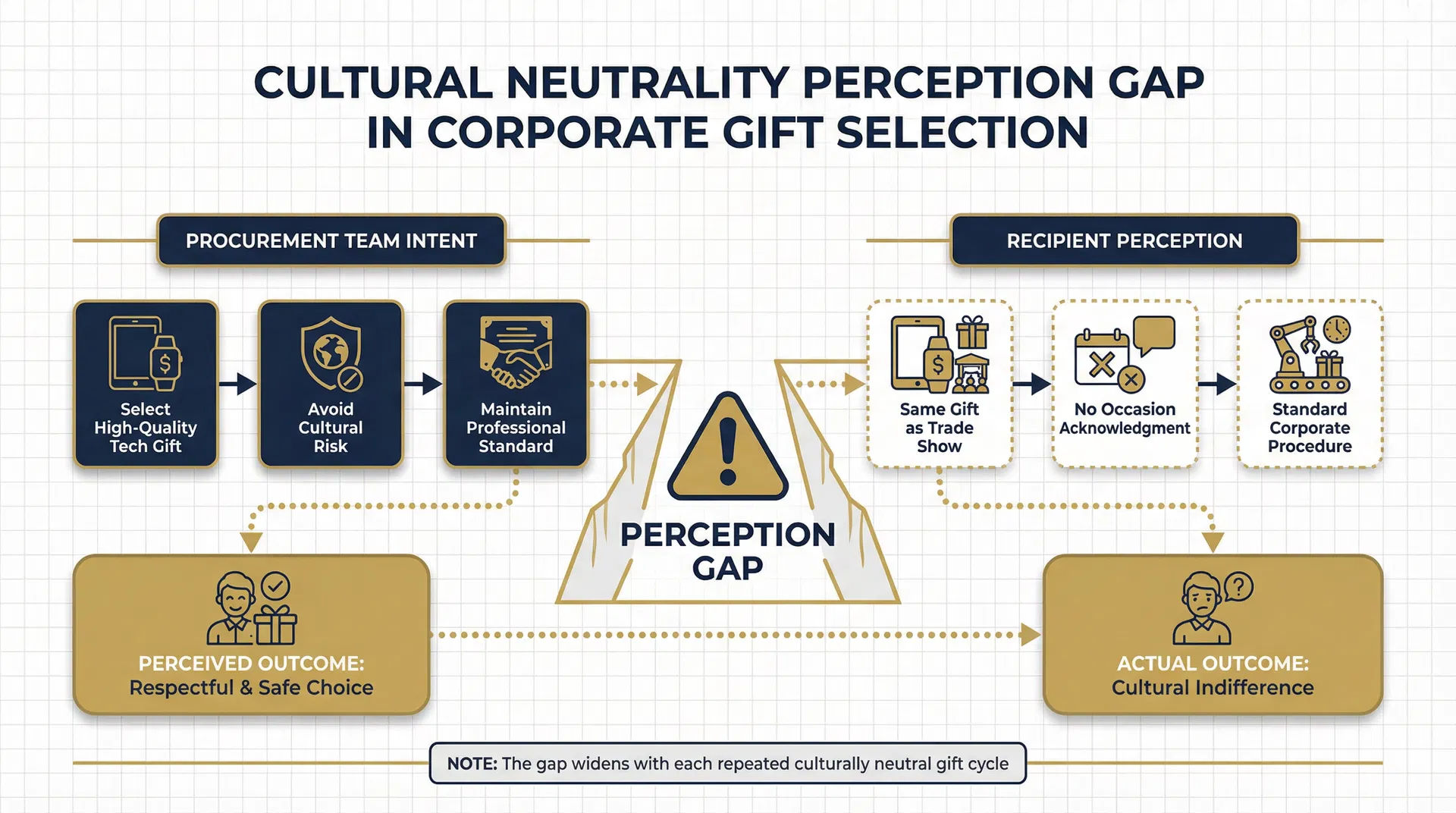
In practice, this is where corporate gift type decisions for culturally significant occasions begin to diverge from what procurement teams believe they are communicating. The internal narrative is: we selected a high-quality, universally appropriate tech gift that avoids any cultural risk. The recipient's interpretation is: this company sends the same gift regardless of the occasion, which means the occasion does not matter to them. The gap between intent and perception is substantial, and it compounds over multiple gifting cycles.
!Diagram showing how procurement team intent diverges from recipient perception when culturally neutral tech gifts are selected for significant cultural occasions A client who receives the same category of culturally neutral tech gift during Ramadan, National Day, and a standard business meeting across eighteen months draws a clear conclusion about the company's level of cultural investment in the relationship.
The resolution does not require abandoning tech gifts for cultural occasions. Technology products remain highly valued in the UAE corporate environment, and branded tech accessories from suppliers like those offering different gift types for specific business contexts can serve cultural occasions effectively when the selection process accounts for the occasion's meaning. The adjustment is in how the gift type is contextualised rather than what the product category is.
!Matrix comparing how the same tech gift product should be contextualised differently for standard business, Ramadan, and UAE National Day occasions A wireless charging station presented in standard corporate packaging for a trade show is appropriate. The same wireless charging station presented in bespoke packaging with Ramadan-specific design elements, accompanied by a culturally appropriate complementary item—premium dates, artisanal Arabic coffee, a handwritten note referencing the holy month—transforms the gift from culturally neutral to culturally engaged without changing the core product.
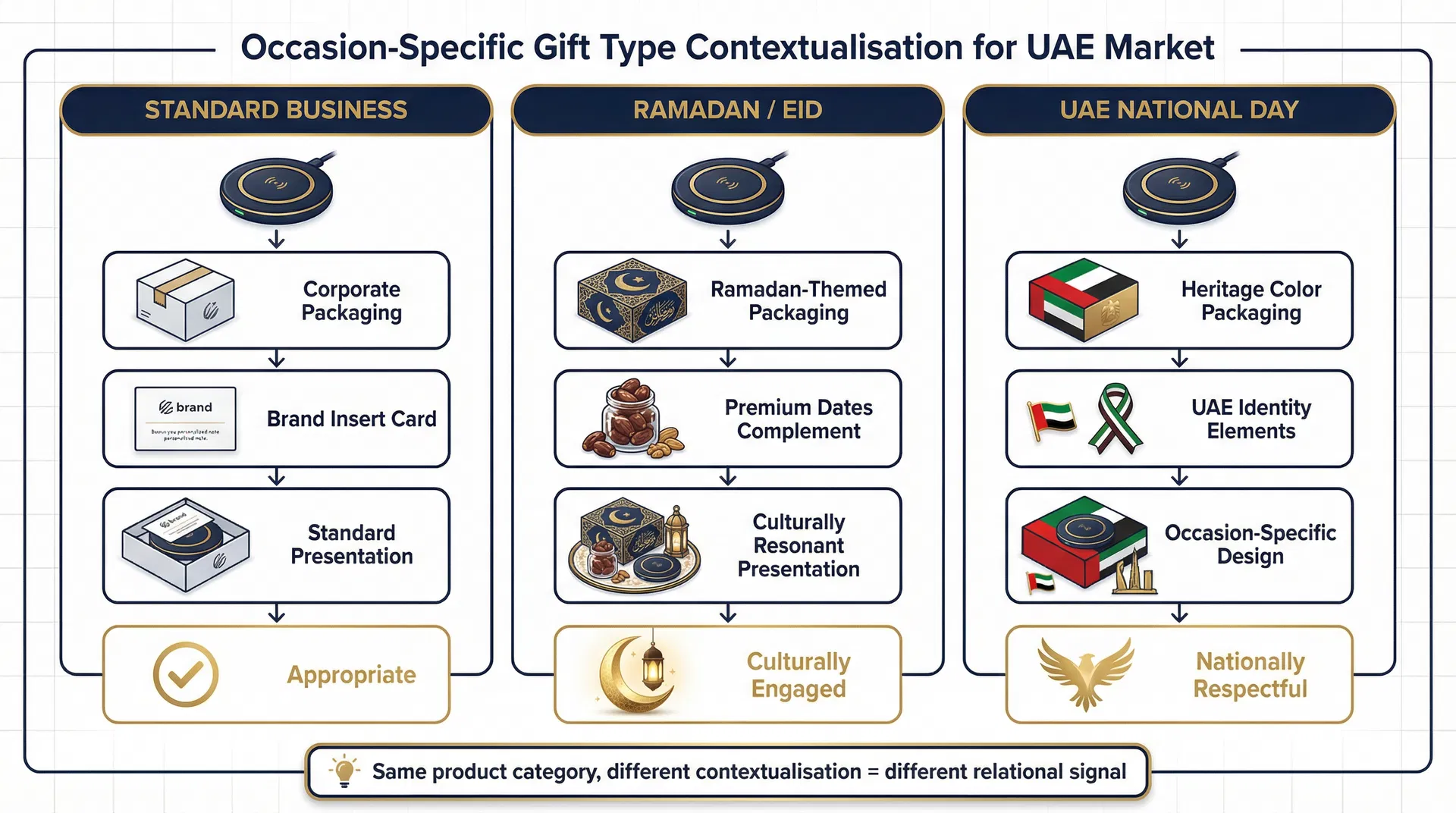
The procurement discipline required here is occasion-specific gift type contextualisation. This means maintaining a matrix that maps each major cultural and business occasion to specific presentation requirements, complementary items, and packaging specifications—even when the base product category remains consistent. The operational overhead is modest: it typically involves two or three packaging variants and one or two complementary item options per occasion type. But the perception difference is significant. Recipients in the UAE business environment are highly attuned to whether a gift reflects genuine cultural awareness or procedural compliance, and the distinction between the two is often determined not by the product itself but by how its presentation acknowledges the specific occasion.
The most reliable indicator that a gifting programme has fallen into the cultural neutrality trap is when the same gift specification—product, packaging, insert card, presentation box—ships unchanged across Ramadan, National Day, and standard corporate occasions. When the procurement file shows identical specifications across culturally distinct moments, the programme has optimised for operational simplicity at the expense of relational effectiveness. In a market where business relationships are built on demonstrated cultural fluency, that trade-off carries costs that no unit-price efficiency can recover.