Multi-Port Corporate Chargers: Why Total Wattage Is Not Power Per Device
Published · Updated · Written by Compliance Review Desk
Written by: Emirates Tech Works Compliance Review Desk
Reviewed by: Emirates Tech Works Procurement Editorial Team (Procurement scope review). This is an organisational review role, not an individual endorsement.
For a UAE corporate tech-gift programme, a 65W multi-port charger or power bank does not give every connected device 65W. The headline figure may be the total capacity shared by a group of ports. What each recipient device can use depends on the product’s allocation design, the active ports, the connected devices, their negotiated profiles, the cable path and—where the exact product documentation identifies it—the order in which devices are attached. The usable specification is therefore a documented simultaneous-use scenario, not the largest wattage printed on the gift.
The decision variable is aggregate output versus dynamic multi-port power allocation
A corporate buyer can approve a high-output device for a mixed recipient group and still create an avoidable expectation gap. The usual source of the error is simple: the total rating is copied into a comparison sheet as though it were a per-port entitlement. A 65W charger or power bank may be capable of delivering that amount through one port when it is the only active output. Once a second device is connected, the product may redistribute its available power according to a shared-capacity design. The rating has not necessarily become inaccurate; it has been read as the wrong type of promise.
USB-IF distinguishes two relevant multi-port concepts. An assured-capacity port can deliver its labelled capacity independently of other ports. A shared-capacity port can reach its labelled capacity only while sufficient capacity remains available to its port group. USB-IF states that the group’s total available power is indicated to the user and that shared ports depend on remaining capacity usbif-multiport. This is the boundary that a corporate brief needs to make explicit: a connector count and an aggregate wattage are not an allocation table.
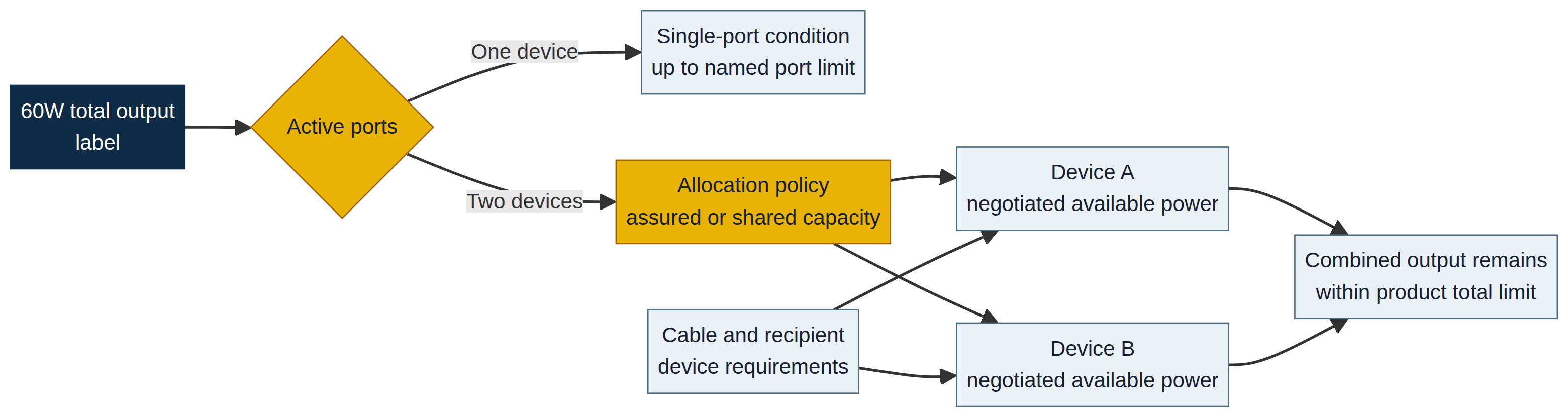
A total-output label answers only one of several purchasing questions
“65W total” is useful information. It states a rated aggregate maximum under the product’s stated conditions; it is not, by itself, a promise of the same sustained output across every input condition, temperature, charge state or port combination. It does not tell a buyer whether one USB-C port can reach 65W, whether two USB-C ports can each provide a defined level at the same time, whether a USB-A port changes the result, or whether connecting a second device causes the first one to renegotiate its charging contract.
The distinction is visible in Apple’s documentation for its named 35W Dual USB-C Port Power Adapter. With one device attached, the adapter can direct its available output to that device. With two devices attached, Apple says power is automatically distributed based on their requirements. Its examples allocate up to 17.5W to each of two Mac, iPhone or iPad devices, or up to 27.5W and 7.5W when a Mac or iPhone is charged together with an Apple Watch or AirPods apple-dual. Those figures are specific to Apple’s 35W adapter and must not be copied to another product. They show, however, why an aggregate number alone does not describe two-device use.
| Label or claim | What it can establish | What it does not establish |
|---|---|---|
| 65W total output | The product has a stated aggregate power ceiling | The power each port receives when other ports are active |
| USB-C1: 65W | A named port may reach a stated maximum in a defined condition | That USB-C1 retains 65W while USB-C2 or USB-A is also used |
| Dual USB-C ports | Two compatible USB-C devices can be physically connected | The allocation, priority, renegotiation sequence or sustained result |
| PD charging | The product can participate in USB Power Delivery with compatible equipment | That any connected device receives its preferred fast-charge mode |
| 20,000mAh and 65W | Stored energy and an output-rate claim are both stated | How long a multi-device allocation can be sustained or how it changes during use |
This is where USB-C PD wattage selection for corporate power banks and multi-port allocation must be separated. The earlier wattage decision asks whether a product can meet the intended device group’s one-device charging need. The allocation decision asks what happens when recipients use more than one output at the same time. A product can pass the first question and fail the second without either specification being fraudulent.
Shared capacity changes the recipient experience at the moment a second device is connected
The difficult part is that shared-capacity behaviour is often invisible during sample approval. A buyer may test one laptop, observe the expected charging indication and sign off. At the event, the same recipient plugs in a phone, earbuds or a colleague’s device. The charger can then move to another distribution state. If the procurement record only says “65W PD,” the recipient sees a slower charge or a changed status but no one can tell whether that behaviour matches the approved design.
Texas Instruments illustrates this mechanism in a two-port 36W USB-C PD reference design. With no other active load, a port can advertise the full 36W. When both ports supply power, the example makes each port renegotiate to 18W so that the combined output does not exceed 36W ti-power-sharing. This is an engineering example, not a performance claim for any corporate gift. Its value is explanatory: power allocation can change after another device is attached, and the affected port may need a new contract rather than merely receiving a smaller invisible share.
For a gift programme, the practical question is not whether allocation is “smart.” It is whether the allocation supports the intended moment of use. A travel gift for executives may need to charge one laptop and one phone during a transit delay. An event giveaway may only need to refresh two phones. A desk kit may be expected to serve a phone, a headset and a tablet. These are different simultaneous-use scenarios and should not inherit the same label without evidence.
| Recipient scenario | Decision the buyer needs | Evidence that makes the claim usable |
|---|---|---|
| One laptop during travel | Can the selected port sustain the required laptop charging path on its own? | Exact model’s single-port output table, representative laptop and supplied cable test |
| Laptop plus phone | What allocation applies after the phone is connected, and does the laptop still meet the programme need? | Product-specific two-port distribution table and simultaneous test result |
| Two phones at an event | Does the second phone create an acceptable shared result for both common device groups? | Defined port combination, two representative phones and observed charge behaviour |
| Phone plus low-power accessory | Is there a port-priority or fixed split that makes the primary device useable? | Configuration record that identifies both ports and supported accessory path |
| Three-device desk use | Is this an intended use case or merely a connector count? | Exact allocation matrix, stated limitations and a full combined-use test |
The right answer can be “one device at a time.” That is not a weakness when the product is specified and labelled for it. The failure occurs when a product designed for one priority device is issued as a multi-device charging gift because the outer carton showed several ports.
Device requirements remain separate from the source’s total capacity
Even when a product has enough aggregate capacity, the connected device must accept the available charging path. Microsoft advises Surface users to use a USB-C PD charger that provides the recommended wattage; it notes that a lower-wattage charger may charge slowly or not at all, and identifies sufficient power as a Fast Charging requirement microsoft-surface. A multi-port source cannot turn a reduced allocation into the wattage required by a particular laptop simply because its aggregate label is high.
The complete path also includes the cable. Google’s charging guidance describes the wired path as the phone’s USB-C port, a USB-C cable, a power adapter and the wall outlet google-pixel. In a corporate gift set, the comparable path may be a power bank output, the included cable and the recipient device. The cable’s connector shape is not enough to preserve the intended experience; the related USB-C cable specification decision explains why power, data and product identity need to be recorded separately.
This means a buyer should never write “charges a laptop and phone simultaneously” just because a sample happened to charge both. The accurate statement is narrower: a named finished configuration was tested with a named port combination, cable type and representative device set, under a specified starting condition. If the supplier replaces the power-management board, cable or port configuration after approval, the earlier observation does not automatically carry forward.
The allocation matrix should be part of the finished-gift specification
The most useful supplier document is not a marketing collage of ports. It is an allocation matrix for the exact finished model. This should differentiate single-port output from every simultaneous combination that the programme intends recipients to use. For shared-capacity products, it should also say whether connecting or removing a device can cause a remaining port to renegotiate.
| Specification field | Why it belongs in the purchase record | Common way it is misread |
|---|---|---|
| Exact product model and port naming | Connects the allocation evidence to the delivered hardware | Treating a similar enclosure or port count as the same electrical configuration |
| Aggregate output limit | Defines the available total power ceiling | Reading it as a guaranteed output at every port |
| Single-port output by named port | Establishes the best case for one active device | Assuming the same result remains when another output is used |
| Simultaneous-use allocation table | Shows the stated result for each relevant port combination | Omitting it because the total rating looks sufficiently high |
| Port-priority or connection-order behaviour, if documented for the exact model | Makes a changing recipient experience explainable when that design applies | Assuming first and second connected devices always receive equal treatment |
| Required cable and adapter path | Identifies the conditions behind the claimed result | Substituting a visually similar cable or using an untested wall charger |
| Sustained-test condition | Separates a brief demonstration from the programme’s intended use | Treating a short bench result as an event or travel performance guarantee |
USB-IF’s multi-port material is particularly helpful here because it does not reduce all multi-port products to one behaviour. It distinguishes assured-capacity and shared-capacity implementations, while describing the use of minimum, operating and maximum power information for multi-port management usbif-multiport. Procurement does not need to decide how the power-management electronics are designed. It does need the supplier to disclose the observable outcome for the ports and scenarios being sold, including any documented priority or reconnection behaviour that affects that outcome.
The batch-consistency control guide becomes relevant once that outcome is approved. A production sample that uses one power-management configuration cannot prove that a later lot with a revised component or undocumented substitute still follows the same allocation behaviour. Record the allocation matrix against the approved model and require review before an electrical change is accepted as equivalent.
A four-stage acceptance test catches the mistake before distribution
An effective test does not need to turn the buyer into a USB-PD laboratory. It does need to recreate the claims that recipients will rely on. The following four stages keep the evidence connected to the real programme rather than to an abstract headline rating.
- Verify the single-device baseline. Test each named output with the representative device it is meant to support, using the supplied or stated cable. Record the model, port, starting state and observed charging behaviour. This establishes a baseline; it does not establish multi-port use.
- Test each intended two-device combination. Connect the exact pair in the order a recipient is likely to use. For example, start the laptop, then add the phone; repeat with the phone attached first if the product’s documentation identifies an order-dependent allocation. Observe whether the primary device still meets the defined programme requirement.
- Test the complete declared use scenario. If packaging or campaign communication shows three active devices, test three active devices. If no three-device use is intended, do not imply it through artwork that displays every port populated. The desired use scenario must be written before it can be verified.
- Confirm the final branded configuration. Repeat the relevant scenario on a production-intent sample with the final cable, power source, enclosure and packaging information. If a lot or component changes, assess whether it changes the documented allocation matrix before releasing stock.
This method also protects brand credibility. When a gift says 65W, recipients may reasonably expect the number to describe their use. A buyer does not need to promise every theoretical configuration. It needs to avoid attaching a broad claim to a product whose actual allocation was never defined.
Marketing language should not turn an aggregate ceiling into a per-device promise
A phrase such as “65W fast charging” can be accurate for a product in the right one-device condition. It becomes ambiguous when placed beside two or three illustrated active devices without a corresponding allocation statement. The risk is not only technical. It affects how a recipient interprets a branded gift: a normal shared-capacity transition can look like an unreliable product when the commercial language implied independent high-speed charging everywhere.
The same discipline applies to a power-bank capacity claim. A 20,000mAh product with a multi-port output is not automatically a better two-device gift than a 10,000mAh product. The larger capacity concerns stored energy. The port allocation determines the rate and configuration of output. The capacity comparison for UAE corporate power banks helps define the energy requirement; the current decision asks whether recipients can use the selected outputs in the same way the campaign implies.
For compliance-sensitive programmes, no electrical allocation claim should be treated as a substitute for the wider product evidence. The UAE compliance checklist for branded power banks remains the relevant route for applicable equipment, battery and transport checks. Allocation documentation has a separate job: it makes the stated charging experience specific enough to test and trace.
Five questions UAE buyers ask about multi-port corporate chargers and power banks
Does a 65W multi-port charger give 65W to both USB-C ports?
Not unless the exact product documentation says that each port has assured independent capacity under that two-port condition. USB-IF identifies shared-capacity ports, where the output available at one port depends on remaining capacity in a group usbif-multiport. Ask for the manufacturer’s allocation table for the two active ports, not only the aggregate rating.
Why does a laptop charge more slowly after a phone is connected?
The product may have moved to a shared-capacity allocation or the laptop may have renegotiated its available USB-PD contract. Apple documents this type of redistribution for its own 35W dual-port adapter, and TI illustrates a two-port PD design that changes both ports after the second load is connected apple-dual ti-power-sharing. The exact reason and outcome must be checked against the model in use.
Can two USB-C ports with the same printed rating behave differently?
Yes. Ports can be part of different allocation groups, have different maximums, or respond differently once another port becomes active. Similar connector shapes do not prove identical simultaneous-use behaviour. The product record should name every port and its stated output for the combinations the recipient programme requires.
What should be tested before giving multi-port power banks to executives?
Test the final branded model with the executive device pair that matters—commonly a laptop and phone—using the included cable and the documented or applicable connection order. Confirm the observed outcome against a written allocation statement. A one-device test does not verify a two-device executive travel scenario.
Is a shared-capacity charger unsuitable as a corporate gift?
No. Shared capacity can be entirely suitable when the expected use is defined and the allocation supports it. It becomes a poor decision only when a total-output label is used to imply independent fast charging for several devices without evidence. A smaller, clearly documented configuration is often more useful than a larger but ambiguous one.
The procurement conclusion: approve a simultaneous-use promise, not a headline number
A multi-port charger or power bank should be selected for the real set of devices that recipients will connect together. Aggregate wattage remains important, but it is only the starting point. The buyer needs to know whether the product has assured or shared capacity, how its ports allocate power when devices are added, whether the required device still receives enough power, and which cable and finished configuration were tested.
When the allocation matrix, recipient scenario and production configuration are recorded together, a total-output rating becomes meaningful. Without that evidence, “65W” is only a ceiling. It is not yet a promise about the power a recipient will receive from each port when the gift is used as intended.
Sources
This article uses USB-IF material to distinguish assured-capacity and shared-capacity multi-port architectures. Apple’s 35W Dual USB-C Port Power Adapter and Texas Instruments’ two-port reference design illustrate product-specific and design-specific allocation behaviour; their wattage examples are not universal allocation tables. Microsoft and Google documentation support the separate point that the recipient device, cable and charging path remain part of the observed result. The finished corporate product must be assessed against its exact manufacturer documentation and tested configuration before any simultaneous-use claim is approved.